
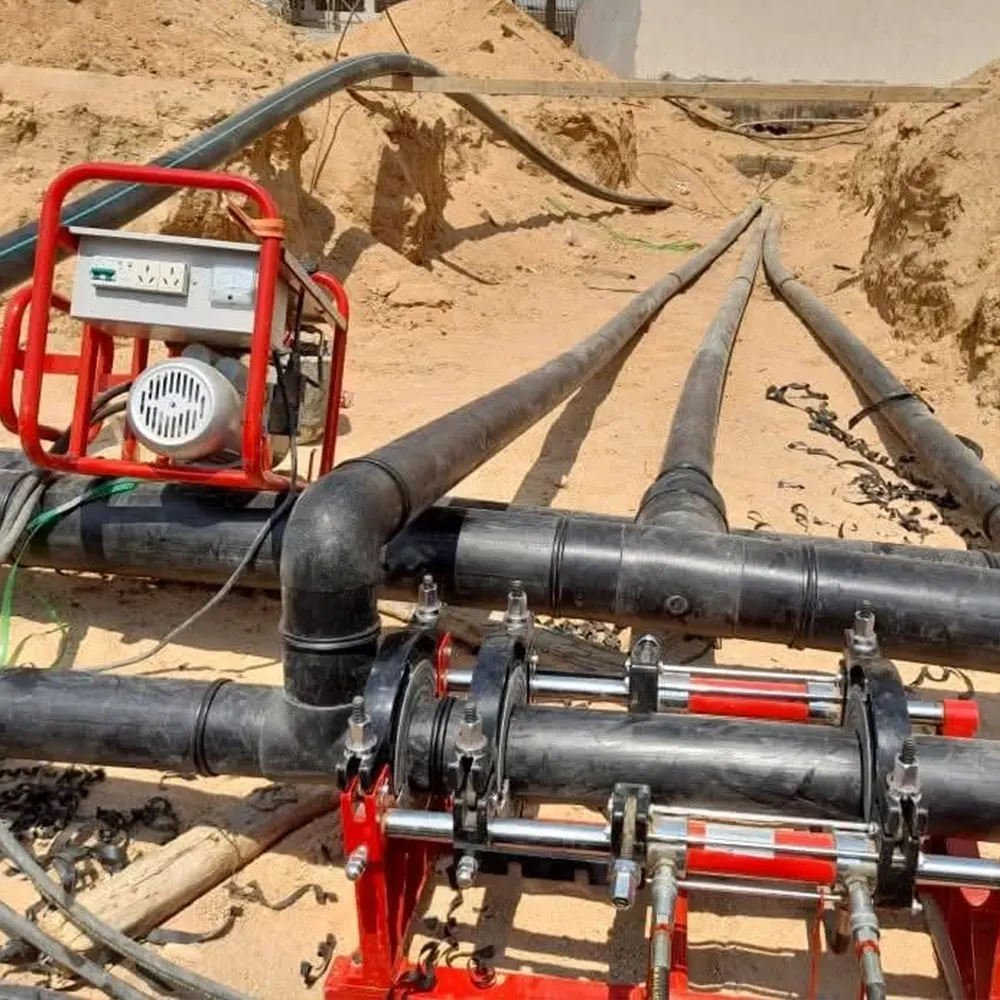
When people compare HDPE and PVC pipe welding, they are usually comparing two very different material behaviors, two different jointing methods, and two different project expectations. Both materials are widely used in water supply, drainage, industrial piping, and utility networks, but the way they are joined can change everything from installation speed to long-term reliability. Understanding the difference is essential for contractors, engineers, distributors, and project owners who want durable, safe, and cost-effective pipeline systems.
HDPE pipe welding is generally based on heat fusion, where the pipe ends are heated and joined under controlled pressure to create a continuous molecular bond. PVC pipe welding, by contrast, is not usually a true fusion welding process in the same sense. In most real-world applications, PVC is connected by solvent cement, mechanical couplings, or special joining systems rather than classic fusion welding. That is why the phrase “HDPE and PVC pipe welding” often creates confusion: the two materials do not respond to heat and pressure in the same way.
Key point: HDPE can be heat-fused into a homogeneous joint, while PVC is typically joined through solvent bonding or fittings. This difference affects strength, leak resistance, installation method, and maintenance requirements.
1. What Makes HDPE Different from PVC?
HDPE, or high-density polyethylene, is a flexible thermoplastic known for its toughness, chemical resistance, and excellent performance in demanding environments. PVC, or polyvinyl chloride, is also a thermoplastic, but it is more rigid and less tolerant of deformation. Because of these material properties, the joining methods for the two pipes are not interchangeable.
HDPE is highly suitable for fusion because when heated to the proper temperature, the pipe ends soften evenly and can be joined under pressure. After cooling, the joint becomes as strong as the pipe itself. This is one reason HDPE is widely used in water supply systems, gas distribution networks, mining projects, and industrial pipeline installations.
PVC is more brittle in comparison and is commonly joined using solvent cement. The chemical adhesive softens the pipe surface and creates a bond as the joint cures. While effective in many applications, it does not create the same unified structure as HDPE fusion. For that reason, PVC installation methods are usually designed around fitting-based connections rather than welding-style fusion.
For projects requiring reliable fusion equipment and technical support, many buyers look for a trusted butt fusion machine supplier that can provide the right solution for HDPE pipeline work.
2. HDPE Pipe Welding: Why Fusion Is the Standard
HDPE pipe welding is usually performed using butt fusion, electrofusion, or socket fusion depending on the pipe size and project requirements. Among these, butt fusion is one of the most common methods for large-diameter pipelines because it creates a strong, leak-free, and permanent connection.
In butt fusion, the pipe ends are aligned, faced, heated, and pressed together under controlled conditions. A proper fusion cycle requires stable temperature, correct pressure, clean pipe surfaces, and accurate alignment. If these factors are managed well, the resulting joint can perform reliably for many years.
Why HDPE fusion is preferred: it provides high tensile strength, excellent sealing performance, corrosion resistance, and flexibility for underground and exposed pipeline systems.
Because HDPE fusion depends on precision, equipment quality matters a lot. A professional butt fusion machine helps maintain temperature accuracy, hydraulic pressure stability, and clamp alignment, all of which directly impact joint quality.
In practical terms, HDPE welding is ideal when the pipeline must resist ground movement, pressure changes, or chemically aggressive environments. It is also favored in long-distance water transport and gas networks because fused joints reduce the risk of leakage over time.
3. PVC Pipe Joining: Why It Is Usually Not True Welding
Unlike HDPE, PVC is rarely joined by fusion welding in standard field applications. The most common method is solvent cement joining, which works by chemically softening the pipe and fitting surfaces so they bond when assembled. This process is often described casually as “welding,” but technically it is a chemical bonding method rather than thermal fusion.
PVC joining is popular because it is simple, fast, and economical for many low- to medium-pressure applications. It is widely used in building drainage, irrigation, vent systems, and some water distribution lines. However, it is less suitable for applications that require high flexibility, long-term joint resilience, or aggressive ground conditions.
One important difference is that PVC systems depend heavily on proper surface preparation and curing time. If the fitting is not cleaned properly or the adhesive is applied incorrectly, the joint can weaken. PVC joints also tend to be more sensitive to impact and temperature variation than HDPE fusion joints.
PVC is practical and cost-effective, but it is not the same as heat-fused HDPE. For demanding industrial or utility pipelines, HDPE fusion usually offers better long-term performance.
4. Main Differences Between HDPE and PVC Pipe Welding
Joining principle: HDPE uses heat fusion to form a molecular bond. PVC usually uses solvent cement or mechanical fitting systems. This is the biggest technical difference.
Joint strength: A properly fused HDPE joint can be as strong as the pipe itself. PVC joints are reliable for their intended use, but they do not form the same seamless structure.
Flexibility: HDPE offers excellent flexibility and can absorb movement better. PVC is more rigid, which can be an advantage in some installations but a limitation in others.
Pressure and environment: HDPE performs well in underground, high-pressure, and corrosive environments. PVC is suitable for many water and drainage systems but is less ideal for harsh conditions or significant ground movement.
Installation method: HDPE fusion requires specialized equipment and trained operators. PVC installation is usually simpler and faster, especially for small-scale systems.
Maintenance expectations: Fused HDPE systems often have lower leak risk over time. PVC systems can be dependable too, but fitting quality and adhesive application are critical.
In short: HDPE welding is about creating a permanent fused pipeline. PVC joining is about assembling a functional piping system with chemical or mechanical connections.
5. Which One Is Better for Your Project?
The better option depends on the application. If your project involves long pipe runs, underground installation, high pressure, or environments where leakage and corrosion must be minimized, HDPE is often the stronger choice. If your project is a building drainage line, irrigation system, or light-duty water application, PVC may be enough and may save time and cost.
For contractors, the decision often comes down to lifecycle value. HDPE can require a higher initial investment in equipment and skilled labor, but the long service life and reduced leakage risk can lower total cost. PVC may be less expensive at the start, but the system design must account for rigidity, joint limitations, and environmental exposure.
Project owners should also consider local standards, operating temperature, soil conditions, and pressure class. In gas distribution, mining, and critical water infrastructure, HDPE fusion is frequently preferred because of its reliability and adaptability.
For companies building a pipeline business or supporting international projects, choosing the right equipment partner is also important. A manufacturer with 20+ years of industry experience can provide better support, better customization, and better consistency. This is where advanced production, strict quality control, and OEM/ODM capability become valuable.
6. Why Equipment Quality Matters in HDPE Welding
HDPE fusion is only as good as the machine and the operator behind it. A high-quality machine should maintain stable heating plate temperature, accurate hydraulic pressure, and precise clamp alignment. If any of these factors drift, the joint quality can suffer.
That is why professional manufacturers focus on testing and quality control at every stage. Temperature accuracy, pressure stability, and mechanical precision are not optional details; they are the foundation of dependable fusion performance. This is especially important for projects in water supply, gas networks, and industrial systems where failure is costly.
Important note: A good HDPE fusion machine does more than heat and press pipe. It helps standardize weld quality, reduce operator error, and improve project efficiency.
7. Typical Applications Where HDPE Has an Advantage
HDPE is widely used in water supply systems because it resists corrosion and supports long-distance transport. It is also common in gas distribution networks due to its strong fused joints and long-term integrity. In mining projects, HDPE handles abrasive conditions well and can accommodate shifting ground. Industrial pipeline installations also value HDPE because it performs reliably in challenging environments.
PVC still has an important role in many systems, especially where cost control and installation simplicity matter most. However, when the priority is joint reliability under stress, HDPE is often the more advanced solution.
To support these applications, JQ-Fusion provides a full range of equipment including hydraulic butt fusion welding machines, automatic butt fusion welding machines, electrofusion welding machines, and multi-angle pipe fitting welding machines. Such product diversity allows contractors and distributors to match the right solution to the job.
8. What Buyers Should Look for in a Fusion Machine Supplier
Buyers should evaluate not only the machine specification but also the manufacturer’s experience, production capability, inventory availability, and after-sales support. A reliable supplier should be able to offer stable stock supply, technical guidance, training support, and customization options for project-specific needs.
For global buyers, OEM and ODM flexibility can also be important. Custom machine size, voltage, color, branding, and configuration can help distributors build a stronger market position. Reliable logistics and fast delivery are also critical when project timelines are tight.
A strong supplier does more than sell equipment. It helps customers solve pipeline installation challenges with engineering support, consistent product quality, and responsive service.
9. Practical Summary of the Difference
If you only remember one thing, remember this: HDPE pipe welding is true fusion welding, while PVC pipe joining is usually solvent-based bonding or mechanical assembly. That single distinction explains the difference in strength, flexibility, reliability, and application scope.
HDPE is the better choice for demanding pipeline systems, especially where leak resistance and long service life are essential. PVC remains useful in many everyday applications, especially when low cost and simple installation are the main goals.
Both materials have value, but they should not be treated as if they behave the same way during installation. Matching the joining method to the material is the key to safe, durable, and efficient pipeline construction.
Frequently Asked Questions
Q1: Can PVC be welded like HDPE?
Usually no. PVC is most commonly joined using solvent cement or mechanical fittings, not heat fusion like HDPE.
Q2: Is HDPE pipe welding stronger than PVC joining?
In most demanding applications, yes. A properly fused HDPE joint can be as strong as the pipe itself and offers excellent leak resistance.
Q3: Which is better for underground projects?
HDPE is often better because it is flexible, corrosion-resistant, and well suited to soil movement and long-term burial.
Q4: Does HDPE welding require special equipment?
Yes. Butt fusion and other HDPE welding methods require specialized machines, accurate temperature control, and trained operators.
Q5: When is PVC a better option?
PVC can be a practical choice for drainage, irrigation, and light-duty systems where lower cost and simple assembly are priorities.



