
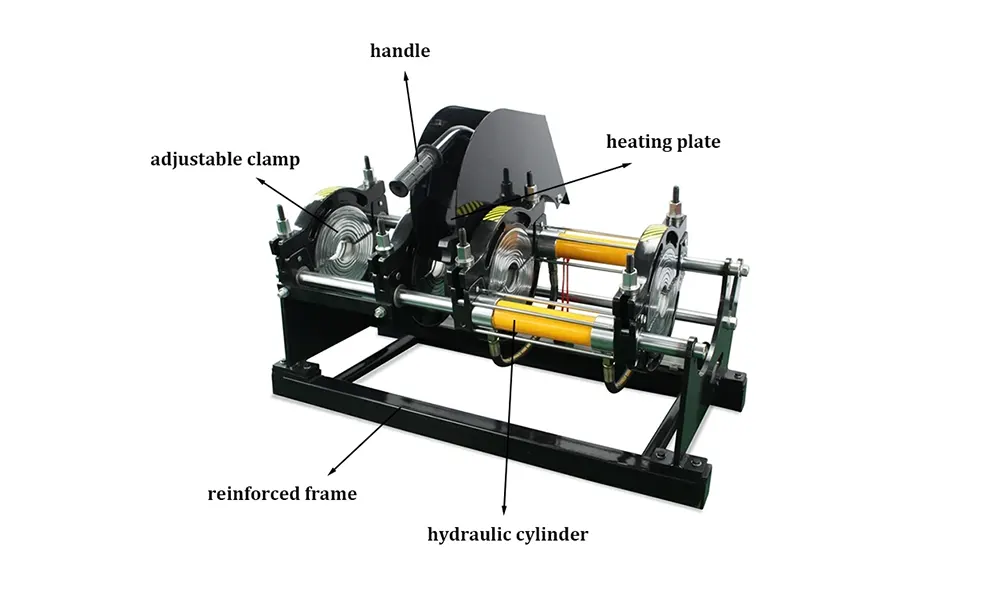
Pipe welding machines have changed dramatically in recent years, driven by stricter quality requirements, faster construction schedules, and the need for safer, more consistent joints. In modern pipeline projects, the machine is no longer just a heating and clamping tool; it has become a smart production system that improves precision, reduces operator error, and supports large-scale infrastructure work across water supply, gas distribution, mining, and industrial pipeline installations.
Today’s latest technologies are reshaping how contractors approach fusion welding. From intelligent temperature control to automation, digital monitoring, and customizable machine configurations, the industry is moving toward higher efficiency and better repeatability. For companies evaluating a butt fusion machine, understanding these innovations is essential for selecting equipment that can handle both current and future project demands.
🔧 Key trend: the most advanced pipe welding machines are designed to combine accuracy, speed, and stable long-term performance while remaining easy to operate in demanding field conditions.
Smart Digital Control Systems
One of the most important developments in pipe welding machines is the integration of smart digital control systems. These systems allow operators to manage heating plates, pressure levels, fusion timing, and cooling cycles with far greater precision than traditional manual methods. In practical use, that means fewer inconsistencies, stronger welds, and improved compliance with project specifications.
Modern control panels often include intuitive interfaces, programmable fusion parameters, and real-time feedback. Some models can store welding data for later inspection, which is especially valuable for contractors who need documentation for quality audits or project handover. This digital approach also reduces dependence on operator experience alone, making the welding process more standardized.
📌 Why it matters: digital control systems help ensure consistent fusion quality across multiple operators, shifts, and job sites.
Automation and CNC Technology
Automation is another major force shaping the latest generation of pipe welding machines. CNC automatic butt fusion welding machines now support a more controlled and repeatable workflow, reducing the risk of human error in critical steps such as alignment, heating, and joining. This is especially useful for large-diameter pipes or projects with strict productivity goals.
Automated systems can handle repetitive tasks more efficiently, allowing teams to complete more welds in less time without sacrificing quality. In high-volume projects, automation becomes a direct advantage because it improves throughput while maintaining the same welding standards from start to finish.
For many contractors, the appeal of automation is not only speed but also reliability. When welding parameters are pre-set and monitored by intelligent systems, every completed joint is more likely to meet the required performance benchmarks. This is particularly relevant in infrastructure projects where joint integrity is critical.
Hydraulic Stability and Precision Clamping
Hydraulic technology remains a core element in advanced butt fusion equipment, but recent improvements have made these systems more stable, more responsive, and easier to control. Hydraulic butt fusion welding machines now provide better pressure consistency during the fusion process, which is essential for forming strong and durable pipe joints.
The precision of the clamping system also plays a major role. When pipe ends are aligned correctly and held firmly in place, weld quality improves significantly. Modern clamping mechanisms are designed to reduce misalignment and maintain a secure grip even under challenging site conditions.
⚙️ Important advantage: improved hydraulic pressure control supports more stable welding results, especially for larger pipe sizes and demanding field applications.
Temperature Accuracy and Heating Plate Innovation
Temperature control is one of the most critical technical factors in pipe welding. If the heating plate is too hot or too cool, the fusion quality may suffer. The latest machines address this challenge with more accurate heating systems, better sensor integration, and faster temperature recovery.
Advanced heating plates are designed to distribute heat evenly across the contact surface. This helps ensure uniform melting of pipe ends and reduces the chance of weak spots in the final weld. In addition, many modern machines are built to maintain temperature stability over long working sessions, which is essential for continuous project execution.
Some systems also include protective coatings or improved surface treatments that extend the service life of the heating plate and make maintenance easier. For companies working on remote projects, this durability can lower downtime and reduce replacement costs.
Data Logging and Traceability
Traceability has become increasingly important in pipeline construction, especially in sectors where safety and regulatory compliance are non-negotiable. The latest pipe welding machines often include data logging functions that record fusion temperature, pressure, welding time, and operator information.
This data can be used to verify that each weld was completed under the correct conditions. It also helps project managers identify process issues early and improve future operations. For distributors and contractors, traceability adds value by creating a more professional and transparent quality management process.
In many cases, digital records are now expected as part of project documentation. Machines with built-in logging capabilities support this requirement and simplify the inspection process for both internal teams and third-party auditors.
Modular Design and Customization
Another key trend in pipe welding technology is modular machine design. Instead of offering only fixed configurations, manufacturers are increasingly providing flexible options that can be adapted to different pipe diameters, voltage requirements, and project environments. This is particularly important for international contractors who work across multiple regions with varying standards.
Customization may include machine size, control system options, branding, color, and functional upgrades. For example, a contractor may need a compact unit for limited job sites, while another may require a heavy-duty machine for large-scale infrastructure projects. A modular approach makes it easier to match the equipment to the exact operational need.
✨ Customization benefit: a tailored machine can improve efficiency, reduce unnecessary features, and support better long-term return on investment.
Durability, Quality Control, and Manufacturing Standards
The latest technologies are not limited to machine operation; they also extend to manufacturing quality. High-end pipe welding machines are now built with stronger machining precision, better component integration, and stricter quality inspection systems. These improvements contribute directly to longer service life and more stable performance.
Leading manufacturers conduct tests on temperature accuracy, hydraulic pressure stability, clamp alignment, and overall machine operation before delivery. This level of quality control helps ensure that the equipment can withstand real-world construction conditions. It also reduces the chance of unexpected failures during critical work phases.
For global buyers, certifications and compliance with international standards provide additional confidence. Machines that are tested and certified are more likely to meet project requirements and deliver dependable results in diverse applications.
Remote Support and Faster Technical Service
As welding projects become more complex and geographically dispersed, technical support has also become more advanced. Many manufacturers now offer remote guidance, faster response times, and better logistics support to help customers solve problems quickly and keep projects moving.
This support model is especially useful when a machine is deployed in a remote area or across multiple job sites. Instead of waiting for lengthy onsite troubleshooting, operators can receive step-by-step assistance, product selection advice, and after-sales support with minimal delay. In a competitive project environment, that kind of responsiveness can be just as important as the machine itself.
Reliable support also helps users get the most out of automation and digital systems. Since modern machines may include more advanced controls, training and technical guidance play a larger role in achieving consistent welding outcomes.
How JQ-Fusion Reflects These Latest Technologies
JQ-Fusion is a professional manufacturer specializing in HDPE pipe welding machines and butt fusion solutions for global pipeline projects. With more than 20 years of industry experience, the company focuses on manual, hydraulic, and CNC automatic butt fusion welding machines for a wide range of pipe diameters. Its product range includes hydraulic butt fusion welding machines, automatic butt fusion welding machines, electrofusion welding machines, and multi-angle pipe fitting welding machines.
The company’s factory capability and engineering strength support modern production lines, precision machining, and strict testing procedures. This means each machine is designed for stable welding performance, high efficiency, and long service life. JQ-Fusion also provides OEM and ODM customization, helping customers adapt equipment to specific project or branding needs.
For contractors and distributors seeking dependable equipment, the combination of advanced manufacturing, quality control, and global support is highly relevant. It shows how current technology is not only about smart features, but also about building machines that deliver practical value in the field.
🏭 Factory strength: advanced manufacturing, strict quality assurance, and fast delivery support are key reasons modern buyers pay attention to the manufacturer as much as the machine.
Why These Technologies Matter for Global Pipeline Projects
In water supply systems, gas distribution networks, mining operations, and industrial pipelines, weld quality affects safety, maintenance costs, and long-term performance. The latest pipe welding technologies help reduce the chances of defective joints, improve work efficiency, and make equipment easier to standardize across teams and locations.
As projects become larger and deadlines tighter, contractors need equipment that can keep up without compromising precision. Smart controls, automation, hydraulic stability, data logging, and customization all contribute to this goal. The result is a more professional workflow that supports productivity and confidence in the final installation.
For many buyers, the right machine is now expected to do more than simply fuse pipes. It should help manage quality, support documentation, and adapt to a variety of project conditions. This broader function is what defines the newest generation of welding machines.
Conclusion
The latest technologies in pipe welding machines are transforming the industry by making welding more precise, more efficient, and more reliable. Digital controls, CNC automation, improved hydraulic systems, accurate temperature regulation, traceability functions, and modular customization are now shaping the standard for modern pipeline work. Manufacturers that combine these technologies with strong quality control and responsive service are better positioned to serve global projects successfully.
For buyers, the key is to choose equipment that matches project scale, pipe diameter, working environment, and performance expectations. As pipeline demands continue to rise, advanced welding technology will remain a critical investment for long-term success.
FAQs
Q1: What is the biggest technological improvement in modern pipe welding machines?
A: Smart digital control systems and automation are among the biggest improvements because they improve consistency, reduce operator error, and make welding more efficient.
Q2: Why is CNC automatic butt fusion technology important?
A: CNC automation helps standardize the welding process, improves repeatability, and increases productivity for large or repetitive pipeline projects.
Q3: How does data logging help in pipe welding?
A: Data logging records key welding parameters, making it easier to verify quality, support inspections, and improve traceability for project documentation.
Q4: Can welding machines be customized for different projects?
A: Yes. Many manufacturers offer OEM and ODM customization for machine size, voltage, design, branding, and project-specific features.
Q5: What should buyers prioritize when choosing a pipe welding machine?
A: Buyers should focus on welding accuracy, control stability, durability, available support, and whether the machine suits their pipe sizes and project environment.



