
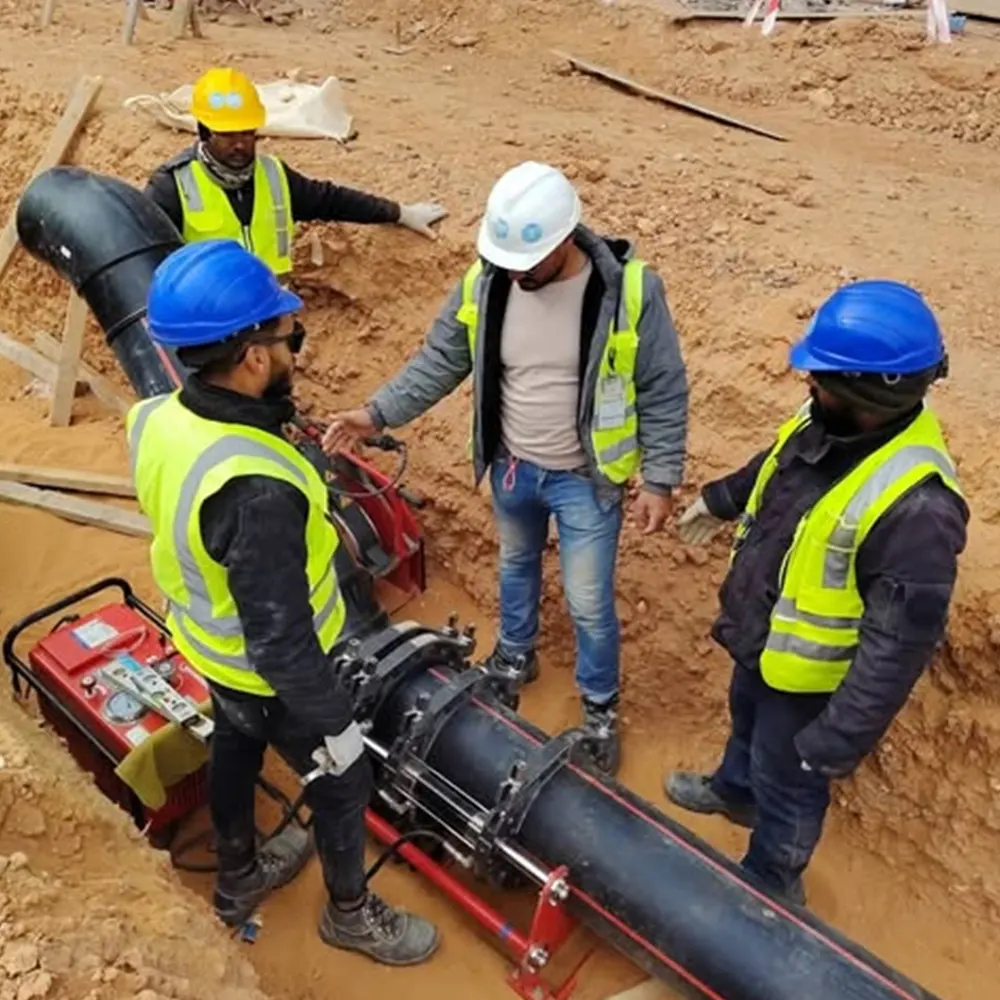
When HDPE pipelines are expected to perform for decades, the quality of every welded joint becomes a deciding factor in system safety, leak prevention, and long-term operating cost. A successful fusion joint is not only created by correct welding parameters, but also proven by careful inspection afterward. That is why project teams, contractors, and inspectors rely on a structured inspection plan to verify that each joint meets the required standard before the line is commissioned.
In HDPE pipe construction, inspection is more than a final checklist item. It is a practical way to confirm that the pipe ends were aligned correctly, heating time was controlled, pressure was stable, and the finished bead reflects a sound fusion process. For teams using a butt fusion machine, inspection also helps demonstrate that the equipment, operator, and site conditions worked together to produce a reliable joint.
Why HDPE Welding Joint Inspection Matters
HDPE butt fusion joints are designed to form a continuous molecular bond, which means the joint should behave like the pipe itself when welded correctly. However, if heat, pressure, or timing is off even slightly, the joint can develop hidden weaknesses that may not be visible immediately. Inspection helps identify visible signs of poor workmanship and reduces the risk of future failure in water supply systems, gas lines, industrial pipelines, and mining applications.
Key point: a visually acceptable bead does not always guarantee a fully sound weld. That is why many projects combine visual checks, dimensional checks, process records, and, when needed, non-destructive testing.
Inspection goals usually include: confirming alignment, verifying fusion bead formation, checking cooling completion, and documenting process consistency for quality control and traceability.
1. Visual Inspection of the Fusion Bead
The most common and immediate method is visual inspection. After the joint has cooled naturally for the required time, the inspector examines the external bead formed by the butt fusion process. A uniform bead is usually a positive sign that the heating face was flat, the pipe ends were aligned properly, and the pressure was applied consistently throughout the cycle.
A good bead should generally appear even, symmetrical, and continuous around the entire circumference. Inspectors look for signs of irregularity such as uneven bead height, discoloration, excessive flash, contamination, or visible gaps. These defects may indicate incorrect temperature, poor surface preparation, or excessive movement during fusion.
Inspector tip: compare the bead all around the pipe. A sudden change in shape at one point often reveals a problem in clamping, alignment, or heating contact.
2. Alignment and Offset Measurement
Proper alignment is critical before and after welding. During inspection, the joint is checked for offset between the two pipe ends. Even if the weld bead looks clean, a significant offset can create stress concentration and reduce the long-term strength of the pipeline. Alignment inspection is especially important in larger diameter pipes where small deviations can lead to major mechanical issues.
This method typically uses simple measuring tools, visual judgment, or alignment indicators built into the machine. For high-standard projects, the allowable offset is controlled according to the project specification or applicable welding standard. The inspector should also verify that the pipe was secured firmly in the clamps and that no movement occurred during the fusion and cooling stages.
Why this matters: good alignment supports even heat transfer and pressure distribution, which are essential for producing a joint that performs like the parent pipe.
3. Bead Size and Shape Evaluation
Beyond general appearance, the shape and size of the bead can provide valuable information about weld quality. Fusion bead dimensions may be checked against accepted process parameters or company standards. An undersized bead can suggest insufficient heat or low pressure, while an oversized or burnt-looking bead may point to overheating or excessive material displacement.
Consistent bead profile is one of the easiest indicators of process control. In many cases, inspectors pay attention to the consistency between the internal and external bead formation as well, especially when process verification is required for critical service pipelines.
Important: bead shape should be interpreted together with process records. A perfect-looking bead is more trustworthy when the heating time, pressure, and cooling time also match the procedure.
4. Process Record Review
A complete inspection approach does not rely on the joint appearance alone. Process records are essential because they show how the joint was made. Inspectors often review temperature logs, pressure values, heating time, changeover time, and cooling duration. These records help confirm that the operator followed the approved procedure and that the machine performed within the required range.
This method is especially useful for projects that require traceability. When combined with joint numbering or welding reports, process documentation makes it easier to audit work quality across an entire pipeline section. It also supports maintenance planning and future failure analysis if a problem ever appears in service.
Best practice: keep inspection records organized by joint number, date, operator, pipe size, and machine setting to simplify project handover and quality review.
5. Non-Destructive Testing Methods
For critical lines, non-destructive testing may be used to supplement visual inspection. Depending on the project requirements and the type of joint, methods such as ultrasonic testing, radiographic evaluation, or pressure-based testing may be applied. These methods help identify internal defects that cannot be seen from the outside.
In HDPE systems, the choice of testing method depends on pipe size, service conditions, local standards, and the level of risk involved. While not every project requires advanced testing, these methods provide additional confidence when the pipeline will carry high-value, hazardous, or difficult-to-access media.
Note: non-destructive testing is usually most effective when used as part of a broader quality assurance system rather than as the only acceptance method.
6. Cooling-Time Verification
Cooling is often underestimated, but it is one of the most important stages in HDPE fusion quality. A joint that is disturbed too early may look fine at first but later develop internal weakness. Inspection should therefore confirm that the joint remained undisturbed until it fully cooled according to the welding procedure.
This verification may be done by checking the machine timer, comparing the elapsed time to the required cooling period, and confirming that the pipe was not moved, twisted, or loaded prematurely. In field projects, especially under hot or windy conditions, cooling discipline has a direct impact on final joint integrity.
7. Surface Condition and Cleanliness Check
Before fusion begins, the pipe ends should be clean, dry, and properly prepared. During inspection, the quality team may review whether dust, grease, moisture, or debris entered the fusion area. Contamination can prevent proper molecular bonding and create weak points inside the joint.
This step is especially important for outdoor jobs where wind, sand, rain, or humidity can affect preparation quality. If the surface was not cleaned correctly before heating, the final bead may still form, but the joint strength may be compromised.
Practical reminder: a clean joint area is one of the simplest ways to improve welding reliability and reduce avoidable rework.
How Equipment Quality Supports Inspection Results
Inspection becomes much easier when the fusion equipment itself is stable and accurate. A machine with reliable temperature control, smooth hydraulic pressure, and precise clamp alignment creates more repeatable results, which in turn makes quality evaluation more consistent. This is why many pipeline contractors choose equipment from experienced manufacturers with strong testing systems and global support.
JQ-Fusion focuses on butt fusion solutions for a wide range of project needs, including manual, hydraulic, and CNC automatic systems. Their machines are used in water supply, gas distribution, mining, and industrial pipeline installations around the world. In projects where traceability and output stability are important, equipment quality directly supports joint inspection confidence.
With more than 20 years of industry experience, JQ-Fusion emphasizes strict testing, OEM and ODM customization, and dependable technical support. This makes it easier for contractors and distributors to match machine performance with project requirements and inspection expectations.
A Practical Inspection Workflow
A simple workflow can help teams inspect HDPE welding joints efficiently without missing key quality points. First, confirm that the welding parameters were recorded correctly. Next, inspect the external bead for uniformity, alignment, and obvious defects. Then verify that cooling time was respected and that the joint was not disturbed. After that, review the process log and compare it with the procedure specification. If the project requires additional assurance, apply non-destructive testing or other acceptance checks.
This sequence supports both speed and reliability. It is also scalable, meaning it can be used for small site repairs or large infrastructure projects involving many joint records.
Common Mistakes Found During Inspection
Several recurring problems appear in poorly controlled fusion work. These include contaminated pipe ends, misalignment, uneven heating, insufficient pressure, premature movement during cooling, and incomplete documentation. Each of these issues can reduce joint performance, even if the weld appears acceptable at first glance.
Another common mistake is relying too heavily on appearance alone. Visual quality is important, but it should be supported by machine records and proper process control. When the inspection system is weak, small defects can pass unnoticed and become expensive failures later.
Quality rule: if a joint does not meet the procedure, it should be corrected or replaced rather than accepted based on appearance alone.
Conclusion
The best HDPE welding joint inspection methods combine visual assessment, alignment measurement, bead evaluation, process record review, cooling verification, cleanliness checks, and advanced testing when needed. No single method is enough for every situation, but together they create a reliable quality control system that protects the pipeline over its full service life. For projects where reliability, speed, and traceability matter, inspection is not just a final step; it is a core part of welding success.
FAQs
Q1: Is visual inspection enough for HDPE fusion joints?
Visual inspection is important, but it is usually not enough by itself for critical applications. It should be combined with process records and, when necessary, additional testing.
Q2: What does a good fusion bead look like?
A good bead is typically even, symmetrical, continuous, and consistent around the full circumference of the pipe.
Q3: Why is alignment inspection so important?
Poor alignment can create stress concentration and weaken the joint, even if the bead looks acceptable from the outside.
Q4: Can machine records help prove weld quality?
Yes. Temperature, pressure, timing, and cooling records provide valuable evidence that the joint was made according to the procedure.
Q5: When should advanced testing be used?
Advanced testing is recommended for critical pipelines, high-risk applications, or projects that require a higher level of quality assurance.



