
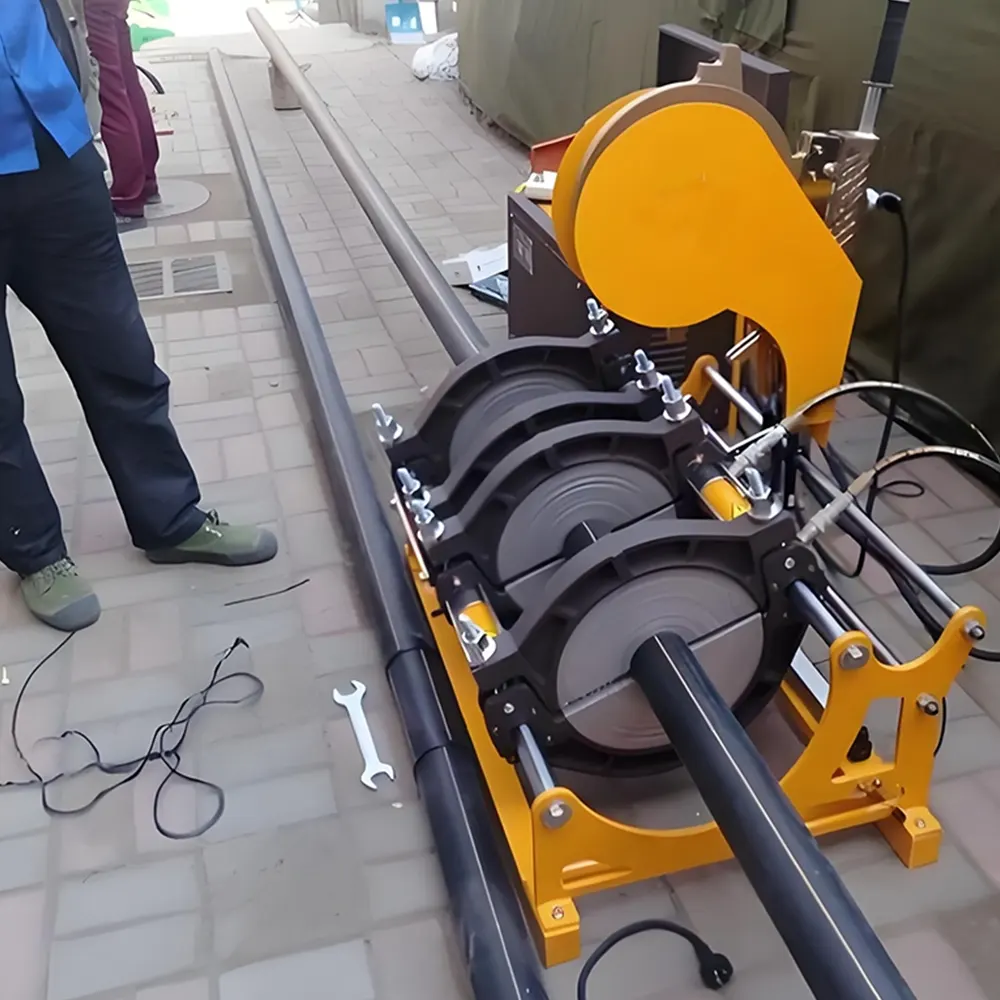
When people ask about HDPE pipe joining, the most important question is often not just what temperature to use, but how to balance temperature, pressure, alignment, and timing to create a strong, leak-free joint. In butt fusion welding, the temperature and pressure settings determine whether the pipe ends melt evenly, form the right melt bead, and cool into a dependable fusion joint. If either value is too low, the weld can be weak; if too high, the pipe may overheat, deform, or lose structural integrity.
For contractors, distributors, and pipeline teams, understanding the welding window is essential for water supply systems, gas distribution networks, mining operations, and industrial pipelines. That is why many buyers prefer a reliable butt fusion machine with stable temperature control and accurate hydraulic pressure. A well-calibrated machine helps ensure consistent results across different pipe sizes, wall thicknesses, and site conditions.
What HDPE Welding Temperature Really Means
HDPE welding temperature is the heat level used to soften the pipe ends before they are pressed together. In butt fusion, the heater plate is responsible for raising the pipe surface to the proper fusion state. The goal is not to burn the material, but to bring it to a controlled molten condition so the two ends can merge into one continuous structure after cooling.
In most HDPE butt fusion processes, the heater plate surface is commonly set around 200°C to 220°C (about 392°F to 428°F). Many field teams use 210°C as a practical working target, but the final setting should always follow the pipe manufacturer’s guidance, local standards, and the specific welding machine instructions.
Key point: The heater plate temperature is not the same as the pipe surface temperature. Heat transfer, ambient temperature, wind, and pipe material conditions all affect the actual fusion result.
Typical HDPE Welding Pressure Guide
Pressure in butt fusion is applied during several stages: initial bead-up, heat soak, changeover, and final fusion. It is not a single fixed number for all projects. Instead, the correct pressure depends on pipe diameter, SDR, wall thickness, machine design, and material grade. The operator must follow the machine’s hydraulic pressure readings and convert them into effective fusion pressure based on the pipe area.
In practical site work, small-diameter pipes often require lower hydraulic force, while large-diameter lines need significantly more pressure to maintain alignment and bead formation. The most important thing is consistency. Pressure should be stable, smooth, and applied at the correct time. Sudden jumps or drops can create poor fusion surfaces or uneven beads.
For this reason, modern hydraulic and CNC systems are widely preferred because they improve repeatability and reduce operator error. A properly maintained machine gives better control over fusion pressure, helping teams achieve reliable joints even in challenging project conditions.
The 4 Main Stages of Butt Fusion Welding
Successful HDPE welding is not only about temperature and pressure. It is about applying the right combination of heat, force, and timing at each stage. The process generally includes four steps:
1. Facing and alignment
The pipe ends are trimmed and aligned so the surfaces match perfectly. Any contamination, ovality, or misalignment can weaken the final weld.
2. Heating and bead formation
The heater plate brings the pipe ends to fusion temperature. A uniform melt bead should begin to form around the pipe circumference.
3. Changeover
The heater plate is removed quickly, and the pipe ends are brought together before significant heat loss occurs. This stage must be fast and precise.
4. Fusion and cooling
Pressure is maintained while the joint cools and solidifies. Cooling time is critical because moving the pipe too early can damage the weld.
How to Judge the Correct Welding Result
A good HDPE fusion joint usually shows a consistent bead around the pipe. The bead should look symmetrical, smooth, and evenly distributed. The pipe ends should be fully aligned, and the joint should not show excessive burning, excessive flash, or visible voids. A successful weld also feels stable after cooling and passes visual and mechanical inspection.
If the temperature is too low, the bead may be too small or irregular, and the fusion bond may not be strong enough. If the temperature is too high, the bead may become overly soft, glossy, or distorted, and the pipe edges may degrade. Incorrect pressure can also cause problems, such as squeezed-out material, poor contact, or internal stress.
That is why experienced operators combine observation with machine data. Temperature, pressure, heating time, changeover time, and cooling time must all work together. When these factors are controlled properly, the result is a durable joint suitable for long-term pipeline service.
Factors That Affect HDPE Welding Temperature and Pressure
There is no single “one-size-fits-all” welding setting. Several factors influence the final values used on site:
Pipe size and wall thickness: Larger and thicker pipes usually need different heating and fusion pressure compared with small pipes.
Pipe material grade: Different HDPE grades may respond slightly differently to heat and pressure.
Ambient temperature: Cold weather can reduce heat retention and may require careful adjustment of timing.
Wind and site conditions: Outdoor conditions can affect heater efficiency and cooling behavior.
Machine accuracy: A precise heating plate and stable hydraulic system make the job much easier and more consistent.
Operator skill: Proper training is essential because even the best equipment cannot fully compensate for poor technique.
Why Stable Equipment Matters in Real Projects
In pipeline construction, the quality of each joint affects the entire line. A weak fusion point can create leaks, pressure loss, maintenance costs, and project delays. For this reason, many companies choose equipment built for stable welding performance, strict temperature accuracy, and smooth hydraulic operation.
JQ-Fusion focuses on producing manual, hydraulic, and CNC automatic butt fusion welding machines for different pipe diameters and project needs. With over 20 years of industry experience, the company supports water, gas, mining, and industrial projects worldwide. Its manufacturing capability, quality control, and customized solutions help buyers match the right machine to their application.
For buyers comparing suppliers, strong technical support, reliable stock, and global shipping are also important. When welding equipment is delivered on time and performs consistently, contractors can keep their schedules on track and reduce operational risk.
Best Practices for Better HDPE Weld Quality
To improve weld results, always start with clean pipe ends and a well-maintained machine. Remove dust, moisture, and oxidation before fusion. Make sure the pipe is clamped correctly and aligned without strain. Check the heater plate temperature regularly, because inaccurate heat is one of the most common causes of weld failure.
It is also important to follow the correct heating and cooling times. Rushing the process may save a few minutes but can reduce the joint’s long-term strength. On the other hand, overheating or excessive pressure can damage the material. The best approach is to follow a consistent procedure and record welding parameters for quality assurance.
Professional teams often create a project-specific welding checklist that includes pipe size, SDR, heater temperature, hydraulic pressure, heating time, changeover time, and cooling time. This helps operators repeat successful settings and improves traceability across the entire project.
FAQ: HDPE Welding Temperature and Pressure Guide
Q1: What is the standard HDPE butt fusion temperature?
The heater plate is commonly set between 200°C and 220°C, with 210°C often used as a practical target. Always confirm the recommended value for the specific pipe and machine.
Q2: Why does welding pressure matter so much?
Pressure controls contact between the heated pipe ends and helps form a strong fusion bond. Too little pressure may lead to a weak joint, while too much pressure can distort the bead and damage the weld.
Q3: Can I use the same settings for all HDPE pipes?
No. Settings change based on pipe diameter, SDR, wall thickness, material grade, and field conditions. Each project should use parameters suited to the specific application.
Q4: How can I tell if the weld is good?
A good weld usually has a uniform bead, proper alignment, no visible burning, and a stable finished joint after cooling. Visual inspection and process records both matter.
Q5: What kind of machine is best for consistent HDPE welding?
A machine with accurate temperature control, stable hydraulic pressure, and strong clamp alignment performs best. Hydraulic and CNC automatic models are often preferred for demanding projects.
For dependable fusion quality, the real goal is not only to know the numbers, but to understand how they work together in practical site conditions. When the correct temperature, pressure, timing, and equipment quality are combined, HDPE pipe joints can deliver excellent long-term performance in demanding pipeline systems.



