
Selecting the right electrofusion welding equipment is critical for achieving consistent, compliant, and durable HDPE pipeline joints. This guide covers the key parameters to evaluate and simple calculation methods to size power, heating time, cables, and other components so you can match equipment to your project needs.
Key Parameters to Consider
Pipe Material & Diameter
Electrofusion performance depends on pipe material (PE80, PE100) and nominal diameter (DN). Larger diameters require higher energy and longer heating cycles. Confirm the pipe SDR (Standard Dimension Ratio) and material grade before selecting a machine.
Power Supply & Current Capacity
Voltage and current capability of the machine must match the electrofusion fittings you plan to use. Typical field units operate at 24V–48V DC for the fitting coil, but the machine’s power inverter and transformer must supply adequate current without excessive voltage drop.
Control System & Data Logging
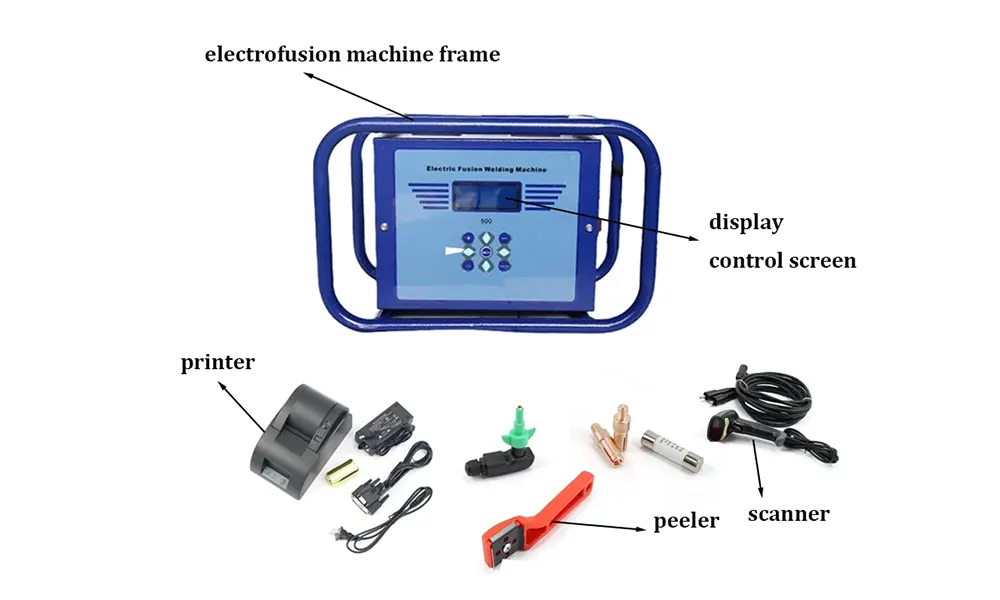
Integrated controllers that log heating profiles, timestamped weld records, and barcode reading for fittings increase traceability and help with quality assurance audits.
Clamping & Alignment
Robust clamps that avoid pipe deformation and ensure concentricity are essential. Adjustable fixtures for different diameters reduce setup time and improve weld quality.
Heating Head & Connector Compatibility
Confirm compatibility between the machine’s connectors and the electrofusion coupler types (socket, saddle, stub-ended). Replaceable heating heads and adaptable leads make the machine more versatile.
Environmental & Safety Features
Look for overcurrent protection, temperature monitoring, and IP-rated enclosures for outdoor use. Machines used in cold climates may require battery warmers or insulated housings.
Portability, Duty Cycle & Maintenance
Consider weight, battery life (if cordless), and recommended duty cycle. For high-volume work, choose equipment with higher duty ratings and easily serviced components.
Calculation Methods: Sizing Power and Heating Time
Basic Electrofusion Heating Principle
Electrofusion heating converts electrical energy into heat in the embedded coil of the fitting. Key relations:
- P = V × I (Power = Voltage × Current)
- Energy E = P × t (Energy = Power × Time)
Estimating Required Heating Time
Use a simple energy balance to estimate heating time for a joint:
t = (m × c × ΔT) / (η × P)
Where:
- t = heating time (s)
- m = effective mass being heated (kg) — mass of the fitting + near-surface pipe
- c = specific heat capacity of PE (~1.9 kJ/kg·K)
- ΔT = required temperature rise (K) — typical melt range 200–260°C but fitting spec defines required ΔT
- η = heating efficiency (fraction, typically 0.4–0.7 in field conditions)
- P = delivered power (W)
Example (approximate): For a small electrofusion coupler where m ≈ 0.02 kg, ΔT = 150 K, c = 1900 J/kg·K, η = 0.5, and P = 200 W:
t ≈ (0.02 × 1900 × 150) / (0.5 × 200) ≈ (5700) / 100 ≈ 57 seconds.
Always follow the fitting manufacturer’s recommended heating time; this calculation helps validate machine capability.
Power Delivery & Voltage Drop
Account for voltage drop across leads and connectors. If Vset is the controller output and ΔV is expected drop, effective voltage at coil is Vcoil = Vset − ΔV. Recalculate P using P = Vcoil × I. Use short, well-sized leads to reduce ΔV.
Cable and Fuse Sizing
Calculate Welding Current
From P = V × I → I = P / V. Example: If a fitting requires 300 W at 24 V then I = 12.5 A. Choose cable cross-section to keep voltage drop minimal and temperature rise acceptable.
Typical Cable Sizing Guideline
Use the following as a starting point (field practice):
| Current (A) | Suggested Cable mm² | Notes |
|---|---|---|
| 0–15 | 1.5–2.5 | Short runs for small fittings |
| 15–30 | 2.5–4 | Medium couplers, moderate duty |
| 30–60 | 6–10 | Large fittings, heavy duty cycles |
Practical Selection Checklist
- Confirm fitting specifications (voltage, power, heating time) before purchase.
- Match machine voltage and maximum current to the largest fitting you plan to weld.
- Choose units with reliable data logging if traceability is required.
- Verify clamp range and adaptability for your pipe diameter spread.
- Assess inverter/battery life for remote or long-shift work.
- Ensure spare leads, connectors, and heating heads are available.
Installation, Calibration & Safety Best Practices
Calibration
Regularly calibrate voltage and current measurement on the controller. Validate delivered energy with a calibrated clamp meter and logging test welds.
Safety & Environmental Notes
Protect operators with insulated gloves and eyewear. In cold environments, allow equipment and fittings to reach ambient working temperature or use approved pre-heaters. Avoid welding in heavy rain unless equipment is rated for wet conditions.
Where to Source Reliable Equipment
For professional-grade HDPE welding and electrofusion solutions, consider manufacturers with proven track records in pipeline infrastructure. JQ-Fusion provides a full range of HDPE pipe welding machines, including electrofusion units and automatic butt fusion equipment suitable for water, gas, and industrial pipeline projects: https://jq-fusionwelding.com/



