
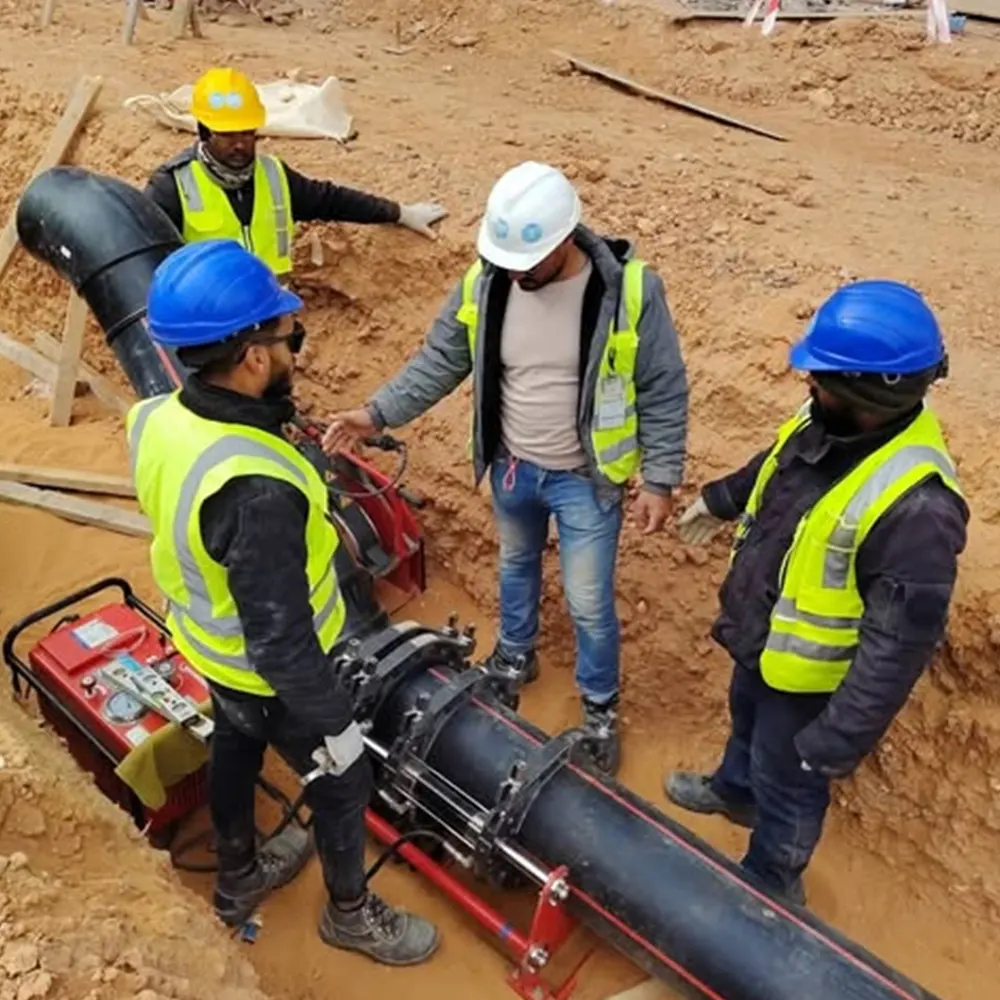
When a gas pipeline project is on the line, the welding method is never just a technical detail. It directly affects safety, sealing performance, construction efficiency, and long-term maintenance costs. That is why the question “Which Welding Machines Are Approved for Gas Pipelines?” matters so much to contractors, engineers, and distributors working with gas transmission and distribution systems.
In most gas pipeline applications, the approved equipment is not chosen by brand name alone. It must match the pipe material, diameter range, local regulations, operator skill level, and required weld quality. For polyethylene gas lines, the most widely accepted solution is the butt fusion machine, especially when it is designed and tested for HDPE pipeline construction. In many project specifications, butt fusion equipment is preferred because it creates a homogeneous joint that can achieve excellent pressure resistance when used correctly.
For modern gas distribution networks, approved welding machines generally fall into three categories: manual butt fusion machines, hydraulic butt fusion machines, and CNC automatic butt fusion machines. In some cases, electrofusion equipment is also accepted for fittings, repairs, and complex joint locations. The final approval depends on how well the machine supports consistent heat control, pressure control, and alignment accuracy during the welding cycle.
Why Gas Pipelines Require Specialized Welding Equipment
Gas pipelines operate under strict safety requirements because even a small joint defect can lead to leakage, service interruption, or serious hazards. Unlike ordinary utility piping, gas systems demand extremely reliable fusion quality and repeatable welding procedures. Approved welding machines must help operators produce stable joints with minimal human error, especially in field environments where weather, terrain, and working conditions may vary.
For HDPE gas pipelines, the machine must maintain accurate temperature, proper pressure, and correct pipe-end alignment throughout the weld. If any of these factors drift outside the accepted range, the joint strength can be compromised. This is why many project owners and inspectors favor machines that offer stable control systems, clear operating procedures, and reliable traceability.
Key point: For gas pipelines, approval is usually based on the welding process quality, not only the machine label. A machine must be capable of producing repeatable, code-compliant welds in real project conditions.
1. Manual Butt Fusion Machines for Smaller Gas Projects
Manual butt fusion machines are commonly used for smaller diameter gas pipelines, branch lines, and temporary works where portability and simplicity are important. These machines are especially useful for contractors who need a practical solution for limited-scale installation or maintenance tasks. They usually rely on the operator to control the fusion cycle, which makes training and experience very important.
When used within the proper size range and operated by trained personnel, manual machines can be accepted for gas pipeline work. However, because they depend more heavily on operator judgment, they are typically better suited to projects where the diameter is modest and the specification does not require advanced automation or full digital recording.
Best for: small-diameter gas lines, site repair, mobile crews, and cost-sensitive projects.
2. Hydraulic Butt Fusion Machines for Most Professional Gas Pipeline Installations
Hydraulic butt fusion machines are among the most widely approved options for gas pipeline construction. They provide stronger clamping force, more stable pressure control, and better repeatability than fully manual systems. For many professional contractors, this is the standard choice for gas distribution networks because it helps reduce operator variability and improve weld consistency.
These machines are especially valuable when welding medium and large pipe diameters, where even minor pressure fluctuations can affect joint integrity. Hydraulic models are commonly specified in gas projects because they support controlled fusion cycles and can handle frequent welding tasks with greater stability. Many pipeline teams rely on them for urban gas distribution, industrial gas lines, and utility expansion projects.
JQ-Fusion, as a professional manufacturer of HDPE pipe welding equipment, offers hydraulic butt fusion solutions designed for global pipeline projects. Their equipment is developed for reliable performance, long service life, and practical field use, which makes it suitable for contractors working under demanding conditions. Learn more through the official website: JQ-Fusion welding solutions.
3. CNC Automatic Butt Fusion Machines for Higher Control and Traceability
For gas pipeline projects that require strict process control, CNC automatic butt fusion machines are often the most advanced approved option. These systems automate key welding parameters such as heating time, transition timing, pressure application, and cooling stages. That automation improves consistency and reduces the chance of human error, which is extremely valuable on regulated gas infrastructure jobs.
Another major advantage is traceability. In many modern projects, owners and inspectors want weld data recorded and reviewed. CNC machines can support documentation requirements by providing digital records of fusion cycles, making it easier to verify that every weld followed the approved procedure. For critical gas lines, this level of control can make the approval process smoother.
Important: CNC automatic systems are often preferred when project documentation, repeatability, and quality assurance are major priorities.
4. Electrofusion Welding Machines for Fittings and Special Locations
Although butt fusion is the main process for many HDPE gas pipelines, electrofusion welding machines also play a significant role. They are commonly used for fittings, repair work, branches, and locations where butt fusion is difficult to perform due to space limitations or geometry constraints. In gas distribution systems, electrofusion provides a practical method for joining specific components with strong sealing performance.
Because gas pipeline systems often include elbows, saddles, tees, and repair couplers, electrofusion is sometimes approved as a complementary welding method rather than a replacement for butt fusion. It is especially useful when the design or site condition does not allow a large fusion machine to be installed around the pipe.
What Approval Usually Depends On
To understand which welding machines are approved for gas pipelines, it helps to look at the approval criteria. In practice, the machine itself is evaluated together with the welding procedure, operator qualification, and project standards. A machine may be technically capable, but if it cannot support the required process control, it may still be rejected.
The most common approval factors include:
- Temperature accuracy for stable heating performance
- Hydraulic pressure stability to maintain proper fusion force
- Clamp alignment precision for clean pipe-end matching
- Pipe size compatibility for the required project diameter
- Operator training support to ensure proper field execution
- Documentation and traceability where required by the code
How JQ-Fusion Supports Gas Pipeline Projects
JQ-Fusion is a professional manufacturer specializing in HDPE pipe welding machines, including manual, hydraulic, and CNC automatic butt fusion models. With more than 20 years of industry experience, the company focuses on delivering durable and reliable fusion equipment for global pipeline applications. Their machines are widely used in water supply systems, gas distribution networks, mining projects, and industrial pipeline installations.
What makes them especially relevant to gas pipeline work is their combination of manufacturing precision and quality assurance. Each machine undergoes testing for temperature accuracy, hydraulic pressure stability, and clamp alignment before delivery. This kind of inspection is essential when a machine must perform consistently in sensitive gas infrastructure projects.
JQ-Fusion advantages: advanced manufacturing, strict quality control, OEM & ODM customization, fast shipping, and responsive technical support.
Which Machine Is the Safest Choice?
If the question is which welding machine is most widely approved for gas pipelines, the answer is usually a high-quality hydraulic or CNC butt fusion machine, depending on the project size and compliance requirements. For smaller tasks, a manual model may also be approved if it fits the pipe size and the procedure is properly supervised. For fittings and special joints, electrofusion remains a valuable and accepted option.
The safest choice is not always the most expensive machine. It is the one that best matches the pipeline specification, the operator’s skill level, and the approval standard set by the project owner or regulator. In gas work, consistency matters more than convenience, and repeatable quality is always the top priority.
Practical Buying Advice for Contractors
Before purchasing welding equipment for gas pipelines, contractors should confirm the pipe diameter range, pressure class, regional code requirements, and whether the project demands digital records. It is also important to ask whether the supplier provides technical training, spare parts, and after-sales support. These services can be just as important as the machine specification itself.
A strong supplier should be able to recommend the right configuration for the project rather than pushing a one-size-fits-all solution. That is where manufacturers with OEM and ODM capability become valuable, because they can tailor machine size, voltage, color, branding, and functional setup to the customer’s market and project needs.
Conclusion
Approved welding machines for gas pipelines are chosen based on safety, consistency, and compliance. In most HDPE gas applications, butt fusion equipment is the primary solution, with hydraulic and CNC automatic models offering the highest level of process control. Manual systems can still be approved for smaller jobs, while electrofusion machines remain essential for fittings and special locations. For contractors looking for dependable pipeline welding solutions, working with an experienced manufacturer such as JQ-Fusion can make procurement and project execution much easier.
Summary: The best-approved machine is the one that matches the gas pipeline specification, delivers stable weld quality, and supports the required level of inspection and documentation.
FAQs
1. Are butt fusion machines approved for gas pipelines?
Yes. Butt fusion machines are widely approved for HDPE gas pipelines when they meet the project specification and produce compliant welds.
2. Is a hydraulic machine better than a manual one?
For most professional gas pipeline projects, yes. Hydraulic machines provide better pressure control and repeatability, especially for medium and large diameters.
3. When should electrofusion be used?
Electrofusion is often used for fittings, branch connections, repairs, and tight spaces where butt fusion is not practical.
4. What matters most in gas pipeline welding approval?
Temperature control, pressure stability, alignment accuracy, and the ability to produce repeatable, code-compliant welds are the most important factors.
5. Can JQ-Fusion machines be customized for gas projects?
Yes. JQ-Fusion offers OEM and ODM customization, including machine configuration, voltage, branding, and project-specific requirements.



