
In modern pipeline construction, welding quality is not just a technical detail; it is the foundation of safety, durability, and long-term performance. When contractors, distributors, and project managers talk about reliable jointing methods for plastic pipelines, one term appears again and again: the infrastructure pipeline welding guide. This guide is more than a manual. It is a practical framework that helps teams understand welding methods, machine selection, operating standards, and project-specific requirements.
For HDPE, PE, and other thermoplastic pipeline systems, choosing the right equipment can determine whether a project runs smoothly or faces costly rework. A well-designed welding guide helps users compare manual, hydraulic, and CNC automatic systems, understand diameter ranges, and match machine capability to the actual job site. For companies seeking dependable equipment, a trusted supplier such as butt fusion machine manufacturer can make the selection process far more efficient.
What Is an Infrastructure Pipeline Welding Guide?
An infrastructure pipeline welding guide is a structured reference that explains how to join pipe sections safely and consistently in water supply, gas distribution, mining, industrial, and municipal pipeline projects. It usually covers welding procedures, machine types, heating plate requirements, alignment rules, pressure control, cooling times, and quality inspection methods.
The main purpose of the guide is to reduce guesswork. In pipeline welding, even a small error in temperature, pressure, or alignment can weaken the joint. Over time, that weakness may lead to leaks, structural failure, downtime, or safety risks. A practical guide gives teams a repeatable process so that each weld meets the same standard, regardless of operator experience.
Key idea: A welding guide is not only for beginners. Experienced contractors also use it to standardize output, train workers, and improve project consistency across different sites.
Why the Right Welding Guide Matters in Infrastructure Projects
Infrastructure projects are usually large, time-sensitive, and expensive. Water networks must remain leak-free for decades. Gas systems must maintain integrity under pressure. Industrial lines may carry abrasive or chemically active media. In all of these cases, weld quality directly affects operational safety.
A good welding guide helps project teams in several ways:
✅ It defines the correct welding method for each pipe material.
✅ It improves operator training and reduces human error.
✅ It supports quality control and compliance checks.
✅ It helps contractors choose the right machine for the required pipe diameter.
✅ It lowers long-term maintenance and repair costs.
For project owners, this means fewer failures and better lifecycle value. For contractors, it means stronger reputation and lower risk. For distributors, it means being able to recommend equipment that truly matches customer needs rather than just selling a general-purpose machine.
Main Welding Methods Used in Pipeline Infrastructure
Different pipeline systems require different welding approaches. The most common methods in infrastructure projects include butt fusion welding, electrofusion welding, and specialized pipe fitting welding. Each method has its own advantages depending on pipe size, site conditions, and installation requirements.
Butt fusion welding: Ideal for straight pipe joints and large-scale line construction. It creates strong, continuous joints with high reliability.
Electrofusion welding: Often used where space is limited or where fittings and repairs need controlled joining.
Multi-angle pipe fitting welding: Useful for complex layouts and special connection requirements.
Among these, butt fusion remains one of the most widely used methods for infrastructure pipelines because it offers excellent joint strength and consistency. It is especially suitable for water supply systems, gas distribution networks, and mining pipelines where durability matters most.
How Butt Fusion Machines Support Reliable Pipeline Welding
A butt fusion machine is the core equipment for forming a fused joint between two pipe ends. The process typically involves alignment, facing, heating, fusing, and cooling. If each stage is controlled correctly, the resulting weld can perform very close to the pipe body itself.
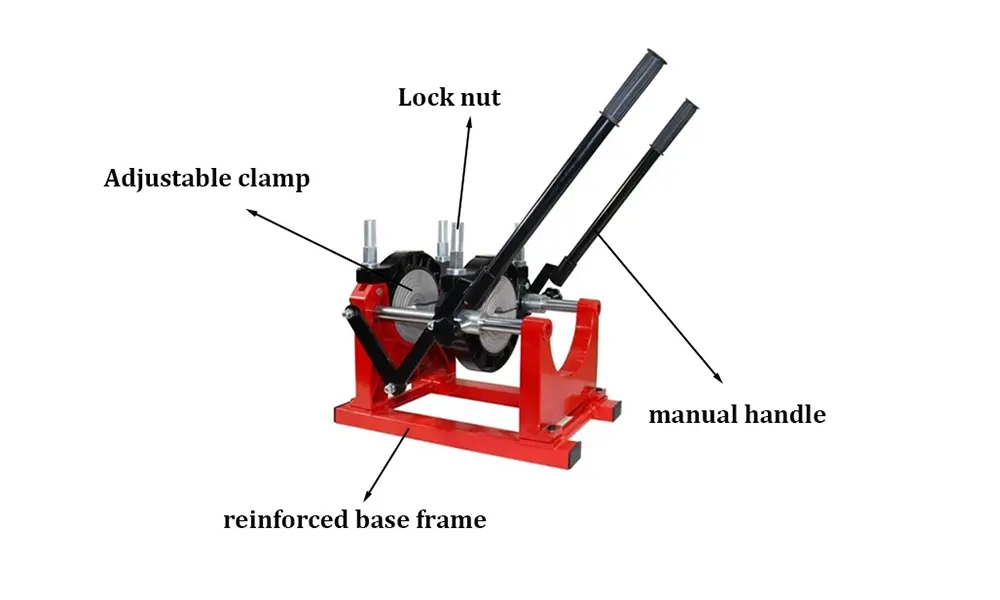
Modern machines are available in manual, hydraulic, and CNC automatic versions. Manual models are suitable for smaller projects or lower budgets. Hydraulic machines offer better control for medium to large pipe diameters. CNC automatic systems help improve precision, consistency, and productivity on demanding sites.
A professional manufacturer with more than 20 years of experience can provide the right combination of machine design and technical support. JQ-Fusion, for example, focuses on reliable HDPE pipe welding solutions for global pipeline projects, offering equipment that spans a wide range of diameters and job requirements.
How to Choose the Right Welding Machine
Selecting the right machine is a balance of project scale, pipe material, diameter range, budget, and operator skill level. The wrong machine can slow the job, increase waste, or create joints that do not meet specifications. To make the best choice, consider the following factors carefully.
1. Pipe Diameter Range – Choose equipment that matches the smallest and largest diameters used in the project. A machine that is too small or too limited will reduce flexibility.
2. Project Environment – If the work is on a remote site, stability, portability, and ease of maintenance become very important.
3. Automation Level – Manual, hydraulic, or CNC automatic options should be matched to the operator’s skill and the required level of precision.
4. Power Supply – Voltage compatibility is critical, especially for international buyers and project sites in different regions.
5. After-Sales Support – Technical guidance, spare parts, and training can be just as important as the machine itself.
6. Customization Needs – OEM and ODM options are useful for businesses that need branding, color changes, configuration adjustments, or project-specific functions.
Practical tip: If your projects vary in pipe size or involve multiple sites, choose a machine family that offers scalable configurations instead of a single fixed model.
What to Look for in a Manufacturer
The manufacturer matters as much as the machine. A reliable supplier should provide stable production quality, strict inspection, and the engineering capability to adapt to real project conditions. This is especially important for international contractors and distributors who need dependable delivery and consistent standards.
JQ-Fusion stands out in several key areas: advanced manufacturing technology, strict quality control, flexible OEM & ODM customization, and reliable global support. Their products are used in water supply systems, gas distribution networks, mining projects, and industrial pipeline installations across the world.
Their product range includes:
• Hydraulic Butt Fusion Welding Machine
• Automatic Butt Fusion Welding Machine
• Electrofusion Welding Machine
• Multi-Angle Pipe Fitting Welding Machine
A certified product line backed by SGS compliance adds another layer of confidence. For buyers, this means the equipment is not only functional but also supported by documentation and quality assurance that can be important in international projects.
The Role of Customization in Pipeline Welding Projects
No two pipeline projects are identical. Some require compact machines for limited workspaces. Others need heavy-duty systems for large diameters and continuous production. This is where customization becomes valuable.
Customized welding solutions can include machine size, voltage, color, brand identity, and configuration changes. For contractors and distributors, such flexibility makes it easier to serve different markets and project demands. For project managers, it means the equipment can be aligned more closely with operational goals.
Why it matters: A customized machine can improve workflow efficiency, reduce setup time, and support better welding results in specialized environments.
Quality Control and Safety Expectations
Reliable welding is built on testing and verification. A strong manufacturer should test temperature accuracy, hydraulic pressure stability, and clamp alignment before shipment. These checks help ensure the machine behaves predictably on site.
Safety is equally important. Well-maintained machines reduce the risk of operator mistakes and help keep project timelines on track. When teams follow the welding guide carefully and use well-tested equipment, the entire pipeline system benefits from stronger, more uniform joints.
Buying Decision Checklist
Before purchasing a welding machine, buyers should ask a few essential questions:
• Does the machine cover the required pipe diameter range?
• Is the control system simple enough for the available operators?
• Can the manufacturer provide technical support and spare parts?
• Is customization available for branding or project needs?
• Does the supplier have proven experience in global pipeline markets?
If the answer to these questions is yes, the buyer is far more likely to choose equipment that supports stable, efficient, and long-lasting pipeline welding performance.
Conclusion
An infrastructure pipeline welding guide is essential for any team working on HDPE and thermoplastic pipeline systems. It helps users understand process control, choose the right machine, and achieve welds that are strong, repeatable, and safe. The right guide saves time, reduces risk, and improves the long-term performance of the entire pipeline network.
For buyers looking for dependable equipment, working with an experienced manufacturer is just as important as selecting the correct welding method. From manual units to advanced CNC systems, JQ-Fusion offers a professional range of solutions designed for real-world infrastructure demands. With strong technical support, customization capability, and quality control, it is easier to match the machine to the project and deliver better results.
Frequently Asked Questions
Q1: What is the main purpose of an infrastructure pipeline welding guide?
It provides step-by-step guidance for welding procedures, machine selection, and quality control to ensure safe and consistent pipeline joints.
Q2: Why is butt fusion so popular in pipeline construction?
Because it creates strong, reliable joints and works especially well for large-scale HDPE and PE pipeline systems.
Q3: How do I know which welding machine is right for my project?
Consider pipe diameter, project environment, automation level, power supply, and after-sales support before choosing a model.
Q4: Can welding machines be customized for different markets?
Yes, many manufacturers offer OEM and ODM options such as voltage changes, branding, color, and functional configuration.
Q5: What should I check before buying from a supplier?
Look for experience, quality testing, certifications, technical support, stock availability, and proven global project performance.



