
When planning a piping project, one of the most frequent questions engineers and contractors ask is: how long does an HDPE pipe welding machine welding time actually take? The answer isn’t a single number — it depends on pipe diameter, wall thickness, machine type, and environmental conditions. Understanding these variables helps you schedule work accurately and avoid costly downtime.
Key Factors That Affect HDPE Pipe Welding Machine Welding Time
Before diving into specific time ranges, it’s essential to recognize what influences the HDPE pipe welding machine welding time. Every jobsite has unique conditions, but the following factors consistently determine how quickly a joint can be completed safely.
- Pipe Diameter and Wall Thickness: Larger pipes with thicker walls require significantly longer heating, soaking, and cooling phases. A 63mm pipe welds in minutes, while a 2000mm pipe may take over an hour per joint.
- Standard Dimensional Ratio (SDR): Pipes with a lower SDR (thicker walls relative to diameter) demand extended heating times. The material volume directly correlates with heat absorption requirements.
- Machine Type: A manual butt fusion machine may take slightly longer due to operator-dependent alignment, whereas a CNC automatic butt fusion welding machine streamlines the cycle through automated pressure control and data logging.
- Ambient Temperature and Weather: Cold environments slow down heat transfer, increasing the soaking time needed to reach proper melt conditions. Wind can also cool the heating plate unevenly, affecting consistency.
- Heating Plate Temperature Stability: Consistent temperature across the entire plate surface is critical. Machines with poor temperature calibration lead to longer or repeated weld cycles, directly impacting HDPE pipe welding machine welding time.
Standard HDPE Butt Fusion Welding Cycle Breakdown
According to ISO 21307 butt fusion procedures, a complete welding cycle consists of several distinct phases. Each phase contributes to the total HDPE pipe welding machine welding time, and skipping or shortening any phase risks joint integrity.
Phase 1: Pipe Preparation and Clamping
Clean the pipe ends, align them in the clamps, and ensure proper fit-up. This stage typically takes 2–5 minutes for smaller diameters but can extend to 15–20 minutes for large-diameter pipes requiring additional handling equipment.
Phase 2: Facing the Pipe Ends
The trimmer planes the pipe ends until continuous shavings appear from both sides. This ensures perfectly parallel, smooth surfaces. Facing usually takes 1–3 minutes, though heavily contaminated or damaged ends may require extra time.
Phase 3: Heating Plate Insertion and Bead-Up
The heating plate is brought into contact with the pipe ends under specified pressure to form an initial melt bead. Bead-up time depends on the material melt flow rate and wall thickness. During this phase, the surface material transitions from solid to molten state.
Phase 4: Soaking (Heat Soak) Period
After the bead-up, pressure is reduced nearly to zero while heat penetrates deeper into the pipe wall. This is the most time-intensive phase and the primary determinant of overall HDPE pipe welding machine welding time. Soaking time is calculated based on wall thickness and pipe diameter, following manufacturer recommendations and standards like PPI butt fusion procedure.
Phase 5: Plate Removal and Joint Assembly
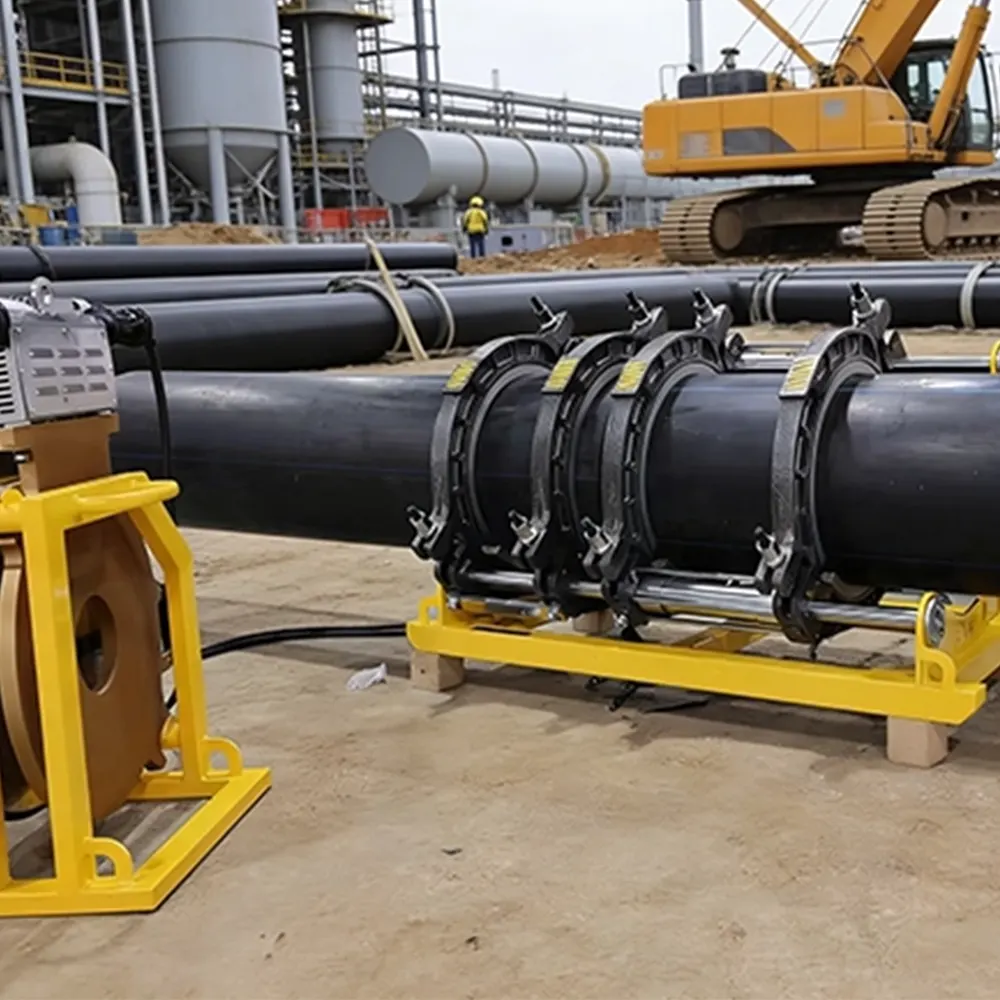
The heating plate is swiftly withdrawn, and the pipe ends are brought together under controlled pressure. This transition must occur within a few seconds to prevent surface cooling. The speed of the hydraulic butt fusion welding machine‘s carriage system plays a significant role here.
Phase 6: Cooling Under Pressure
Once the joint is formed, fusion pressure is maintained while the joint cools and solidifies. Cooling time cannot be rushed — premature pressure release leads to weak joints. This phase often matches or exceeds the heating soak time in duration.
Estimated HDPE Pipe Welding Machine Welding Time by Diameter
The table below provides approximate cycle times for standard SDR 11 pipes under normal ambient conditions (around 20°C / 68°F). Actual HDPE pipe welding machine welding time may vary based on machine model, operator experience, and site conditions.
| Pipe Diameter (mm) | Wall Thickness – SDR 11 (mm) | Heating & Soaking (min) | Cooling Time (min) | Total Estimated Cycle (min) |
|---|---|---|---|---|
| 63 mm | 5.8 | 3 – 5 | 4 – 6 | 8 – 12 |
| 110 mm | 10.0 | 5 – 8 | 8 – 12 | 14 – 22 |
| 200 mm | 18.2 | 10 – 15 | 15 – 20 | 27 – 38 |
| 315 mm | 28.6 | 15 – 22 | 22 – 30 | 40 – 55 |
| 500 mm | 45.5 | 25 – 35 | 35 – 45 | 63 – 83 |
| 800 mm | 72.7 | 40 – 55 | 55 – 70 | 98 – 128 |
| 1200 mm | 109.0 | 60 – 80 | 80 – 100 | 143 – 183 |
| 1600 mm | 145.5 | 80 – 105 | 105 – 130 | 188 – 238 |
Note: Times are approximate and apply to single-joint cycles under optimal conditions. Always refer to your machine’s operation manual and applicable welding standards such as ASTM F2620 heat fusion for precise parameters.
How Machine Automation Reduces HDPE Pipe Welding Machine Welding Time
Automated and CNC-controlled machines significantly reduce total HDPE pipe welding machine welding time by eliminating manual intervention delays and ensuring precise parameter execution. Here is a comparison of machine types and their typical time-saving characteristics:
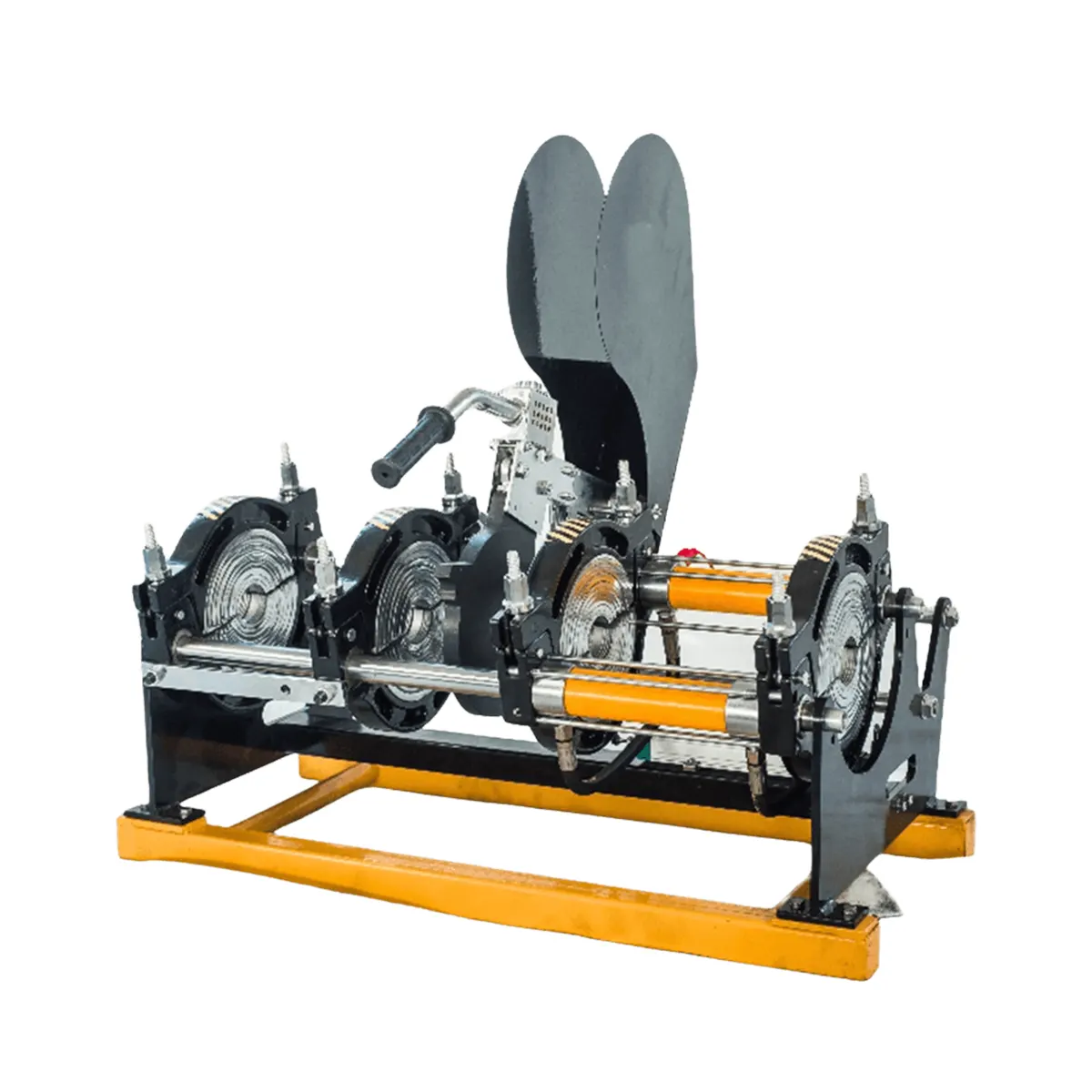
- Manual Butt Fusion Machines: Require operator skill for every step. Setup and alignment adjustments can add 5–15 minutes per joint. Best suited for smaller diameters where speed is less critical.
- Hydraulic Butt Fusion Machines: Powered carriage movement speeds up plate removal and joint closure, reducing transition time. Ideal for mid to large diameters, these machines cut several minutes per cycle compared to fully manual operation.
- CNC Automatic Butt Fusion Machines: Pre-programmed welding parameters, automatic pressure control, and real-time data logging eliminate guesswork. The machine automatically moves through each phase, optimizing HDPE pipe welding machine welding time while maintaining consistent joint quality. Setup time is also reduced since parameters are stored digitally.
Practical Tips to Optimize HDPE Pipe Welding Machine Welding Time
Achieving the fastest possible HDPE pipe welding machine welding time should never compromise weld quality. These practical recommendations help you balance speed with reliability:
- Maintain Heating Plate Cleanliness: PTFE-coated plates that are clean and free of residue transfer heat more efficiently. Contaminated plates cause uneven heating and extend the soak time required.
- Pre-Warm Pipes in Cold Weather: In cold climates, store pipes in a sheltered area or use insulated blankets before welding. This reduces the temperature differential and accelerates the initial heat-up phase.
- Calibrate Equipment Regularly: Verify heating plate temperature accuracy across multiple points. A plate that reads 220°C but has cold spots will produce inconsistent results and potentially require re-welding, effectively doubling your total time.
- Train Operators Thoroughly: Skilled operators can set up, align, and execute each phase with minimal delay. Investing in training ensures that manual or semi-automatic machine cycles proceed without errors that cause restarts.
- Use Proper Pipe Support Stands: Adequate roller supports reduce alignment time, especially for long pipe strings. Misalignment discovered mid-cycle wastes valuable minutes and may necessitate re-facing.
Why Welding Time Compliance Matters for Project Success
Shortcutting the HDPE pipe welding machine welding time by reducing soak or cooling phases is one of the most common causes of field joint failures. A joint that appears sound immediately after welding may develop leaks under pressure if crystallization was incomplete during cooling. For critical applications like gas distribution or high-pressure water mains, ASTM F2620 pipeline safety standards mandate strict adherence to qualified welding procedures.
Conversely, overly conservative time estimates can delay project schedules unnecessarily. Modern machines from experienced manufacturers help you achieve the right balance. JQ-Fusion provides a range of HDPE pipe welding machines designed to meet PE butt fusion equipment standards, ensuring that your welding cycles remain both efficient and fully compliant.
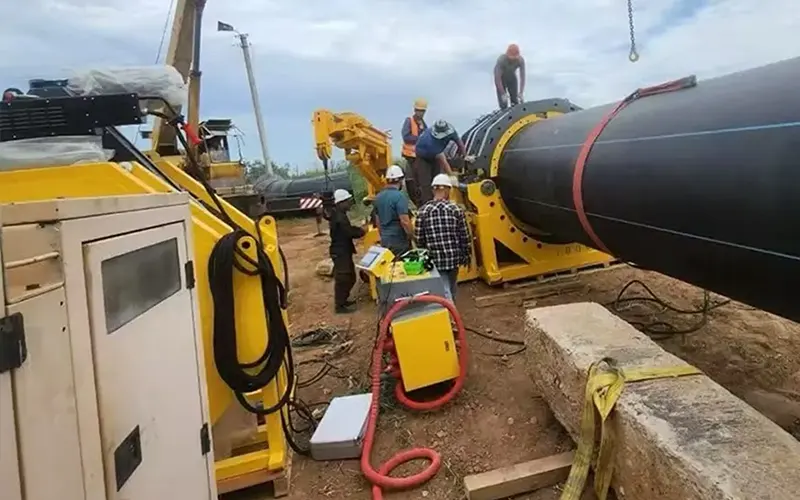
Electrofusion vs. Butt Fusion: Time Comparison
While butt fusion dominates long-run pipeline construction, electrofusion offers an alternative joining method for repairs, tie-ins, and tight spaces. Electrofusion couplers have a fixed energizing time controlled by the processor unit, typically ranging from 30 seconds for small fittings to several minutes for larger ones. However, the overall process including pipe scraping, cleaning, clamping, and cooling still demands careful time management. Each method has its place, and selecting the right one impacts your total installation schedule.
Frequently Asked Questions About HDPE Pipe Welding Machine Welding Time
Can welding time be shortened in warm weather?
Moderate temperature increases can slightly reduce the required soak time, but cutting corners on cooling time is never recommended. The joint must return to ambient temperature under pressure to develop full strength, regardless of external conditions.
How does SDR affect welding time?
Lower SDR values indicate thicker walls, which demand significantly longer heating and cooling periods. For example, an SDR 9 pipe of the same diameter may require 30–40% more total HDPE pipe welding machine welding time than an SDR 17 pipe due to increased material mass.
What is the fastest way to complete multiple welds?
Using multiple machines simultaneously on different joints is the most effective strategy for large-scale projects. While one joint cools, operators can be setting up the next weld on another machine, maximizing daily output without sacrificing joint quality.



