
Municipal engineering projects depend on pipe systems that can handle long service life, stable pressure, and demanding site conditions. Whether the application is water supply, drainage, gas distribution, or utility infrastructure, the welding equipment used on the job can directly affect installation quality, schedule efficiency, and long-term performance. For contractors and project managers, choosing the right butt fusion machine is not just a technical decision—it is a practical investment in safety, productivity, and project reliability.
In municipal works, pipe welding is often required in open trenches, crowded urban construction zones, and remote utility corridors. These environments demand equipment that is stable, easy to control, and capable of producing consistent fusion joints across different pipe sizes and materials. The best pipe welding equipment for municipal engineering projects is therefore not simply the most advanced machine on paper. It is the one that matches the project scale, pipe diameter range, material type, operator skill level, and site conditions while still delivering dependable results.
Why Pipe Welding Equipment Matters in Municipal Engineering
Municipal pipelines are expected to perform for decades with minimal failure. A weak weld can lead to leakage, pressure loss, contamination risks, excavation rework, and costly downtime. That is why the quality of the welding system matters as much as the quality of the pipe itself. Good equipment helps ensure proper heating, alignment, pressure control, and cooling time, which are the key factors behind a strong fusion joint.
For contractors working under tight deadlines, reliable equipment also improves workflow. A well-designed machine reduces human error, shortens setup time, and supports repeatable operation. In large municipal projects, these advantages can save significant labor costs and reduce the risk of inspection failures.
Key point: The best equipment is not the most complicated one. It is the one that delivers stable welding performance, supports the required pipe range, and fits the actual conditions of the project site.
Main Types of Pipe Welding Equipment Used in Municipal Projects
Different municipal applications call for different welding technologies. Selecting the right type begins with understanding the pipe material, joint requirement, and construction environment.
1. Manual Butt Fusion Welding Machines
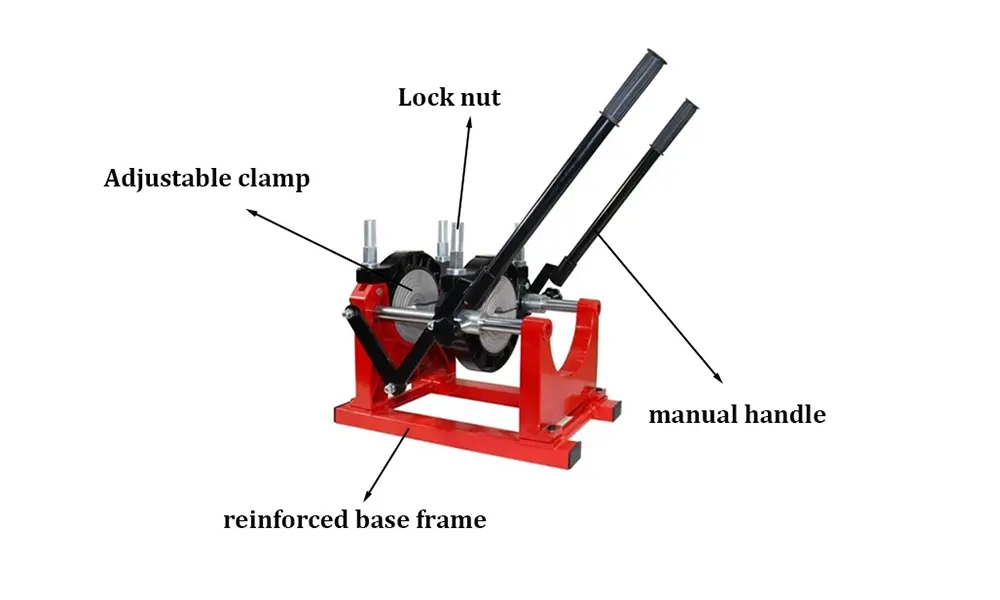
Manual machines are often preferred for smaller-scale projects, repair work, and installations where flexibility is more important than automation. They are straightforward to operate, easier to transport, and suitable for crews that need dependable tools for basic HDPE pipe joining. In municipal maintenance work, manual systems can be especially useful for emergency repairs or compact work zones.
2. Hydraulic Butt Fusion Welding Machines
Hydraulic machines are widely used in municipal engineering because they provide stronger clamping force, better alignment, and more stable pressure control. These features are essential when welding medium to large diameter pipes in water supply or gas distribution networks. They are a strong choice for projects that require precision and repeatability across many welds.
⚙️ Best for: municipal water pipelines, gas pipelines, and large-scale infrastructure installation where joint consistency is critical.
3. CNC Automatic Butt Fusion Welding Machines
For advanced municipal projects or contractors handling repetitive welding tasks, CNC automatic systems offer a major advantage. They help control the heating, joining, and cooling process with a high level of accuracy. This is useful in projects where documentation, process standardization, and quality assurance are important. Automatic systems also reduce operator dependency and improve production efficiency on busy sites.
4. Electrofusion Welding Equipment
Electrofusion tools are commonly used for branch connections, tie-ins, and situations where conventional butt fusion is difficult. In municipal systems with complex layouts, electrofusion provides valuable flexibility. It is often applied in repair work, confined areas, and special joint requirements where a compact and precise solution is needed.
What to Consider When Choosing the Best Equipment
The best pipe welding equipment for municipal engineering projects should be chosen according to several practical factors. These criteria help determine whether a machine is suitable for daily use in demanding field conditions.
Pipe diameter range: Municipal projects often involve varied pipe sizes, from small distribution lines to large transmission mains. The machine should cover the project’s target diameter range without sacrificing alignment quality.
Material compatibility: HDPE is one of the most common materials in modern municipal pipelines. Equipment must be suitable for the material specification and ensure proper heat fusion results.
Site mobility: Some projects require portable machines that can be moved quickly between work areas. Others need fixed or semi-fixed systems for repeated operations. Mobility should be matched to the construction environment.
Control accuracy: Temperature accuracy, hydraulic pressure stability, and clamp alignment all affect weld quality. A machine with strong control features reduces rejection risk and improves joint reliability.
Operator training: Even the best equipment performs poorly if crews are not trained to use it correctly. Simple operation and clear technical guidance are major advantages on fast-moving municipal projects.
Why Hydraulic and Automatic Systems Are Often the Best Choice
In many municipal engineering projects, hydraulic and automatic butt fusion machines are considered the best all-around choices. They combine consistent performance with high efficiency, which is especially useful on long pipeline routes and large infrastructure programs. Their stronger pressure control helps produce uniform welds, while automation reduces the chance of operator variation.
These machines are also well suited to inspection-heavy projects. Because many municipal jobs require strict quality documentation, equipment that can support repeatable settings and stable output becomes a major advantage. This is one reason experienced contractors often choose advanced machines from specialized manufacturers with proven production capability.
Tip: If your project includes both standard pipe runs and demanding tie-in sections, choose equipment that can handle the full range of job requirements rather than a machine built for only one task.
The Role of Manufacturer Quality in Equipment Selection
Choosing the best pipe welding equipment also means choosing the right manufacturer. A machine is only as reliable as the engineering, materials, and quality control behind it. Manufacturers with strong production systems and testing procedures can provide better long-term value because their machines are built for repeatable use in real project environments.
JQ-Fusion, for example, focuses on HDPE pipe welding solutions for global pipeline projects, offering manual, hydraulic, and CNC automatic butt fusion machines. With over 20 years of industry experience, the company supports water supply systems, gas distribution networks, mining projects, and industrial pipeline installations. Its strength lies in advanced manufacturing, strict quality control, flexible OEM and ODM customization, and reliable global support. These qualities matter because municipal contractors need equipment that can be delivered on time and perform consistently on site.
For project teams evaluating suppliers, it is also useful to review product range and technical support capacity. A manufacturer offering multiple machine types, like hydraulic butt fusion welding machine and automatic butt fusion welding machine, can better match equipment to different municipal needs. That flexibility helps reduce procurement complexity and simplifies future expansion.
How to Improve Welding Results on Municipal Projects
Even with the right machine, successful pipe welding depends on disciplined operation. Surface preparation, correct clamping, accurate heating, and proper cooling time all contribute to strong fusion joints. Crews should follow the welding procedure carefully, especially on pressure-bearing municipal systems where a small defect can become a serious issue later.
Project supervisors should also verify machine calibration before use. Temperature deviation or uneven pressure can weaken the fusion process, so regular inspection is essential. In addition, maintaining clean heating plates, properly aligned clamps, and dry work conditions can greatly improve output quality.
🔧 Remember: strong welds come from a combination of the right machine, correct procedure, and trained operators.
Recommended Equipment Features for Municipal Work
When comparing options, municipal contractors should look for features that make work safer and more efficient. Useful features include stable hydraulic systems, accurate temperature controllers, durable clamps, easy-to-read interfaces, and strong frame construction. For larger projects, additional benefits such as data recording, automatic cycle control, and upgradeable configurations can improve productivity and compliance.
Customization is also worth considering. Some municipalities operate under unique voltage standards, environmental constraints, or branding requirements for public works programs. A manufacturer that supports OEM and ODM customization can provide better fit for the project and the client’s business model.
Conclusion
The best pipe welding equipment for municipal engineering projects is the one that balances performance, durability, operator convenience, and project compatibility. For small repair tasks, manual tools may be enough. For larger and more demanding systems, hydraulic and CNC automatic butt fusion machines often provide the best results because they support accuracy, efficiency, and joint consistency. In every case, equipment quality and manufacturer support are essential.
If your project requires dependable HDPE pipe joining, choosing a machine from a trusted supplier with strong technical capabilities can reduce risk and improve long-term results. Municipal infrastructure depends on stable pipelines, and stable pipelines begin with reliable welding equipment.
Frequently Asked Questions
Q1: What type of pipe welding equipment is best for municipal water projects?
Hydraulic butt fusion machines are often the best choice because they provide stable pressure control, reliable alignment, and consistent weld quality for water distribution systems.
Q2: Are automatic welding machines better than manual ones?
Automatic machines are better for large or repetitive municipal projects because they improve consistency and reduce operator error. Manual machines still work well for smaller jobs and repairs.
Q3: What should I check before buying a butt fusion machine?
Check the pipe diameter range, material compatibility, control accuracy, durability, available customization, and after-sales technical support from the manufacturer.
Q4: Why is manufacturer support important?
Good support helps with product selection, installation, training, troubleshooting, and maintenance, which are all important for keeping municipal projects on schedule.
Q5: Can one machine handle different municipal pipe sizes?
Yes, many hydraulic and automatic machines are designed for a range of pipe diameters, but the model should be selected according to the project’s actual requirements.



