
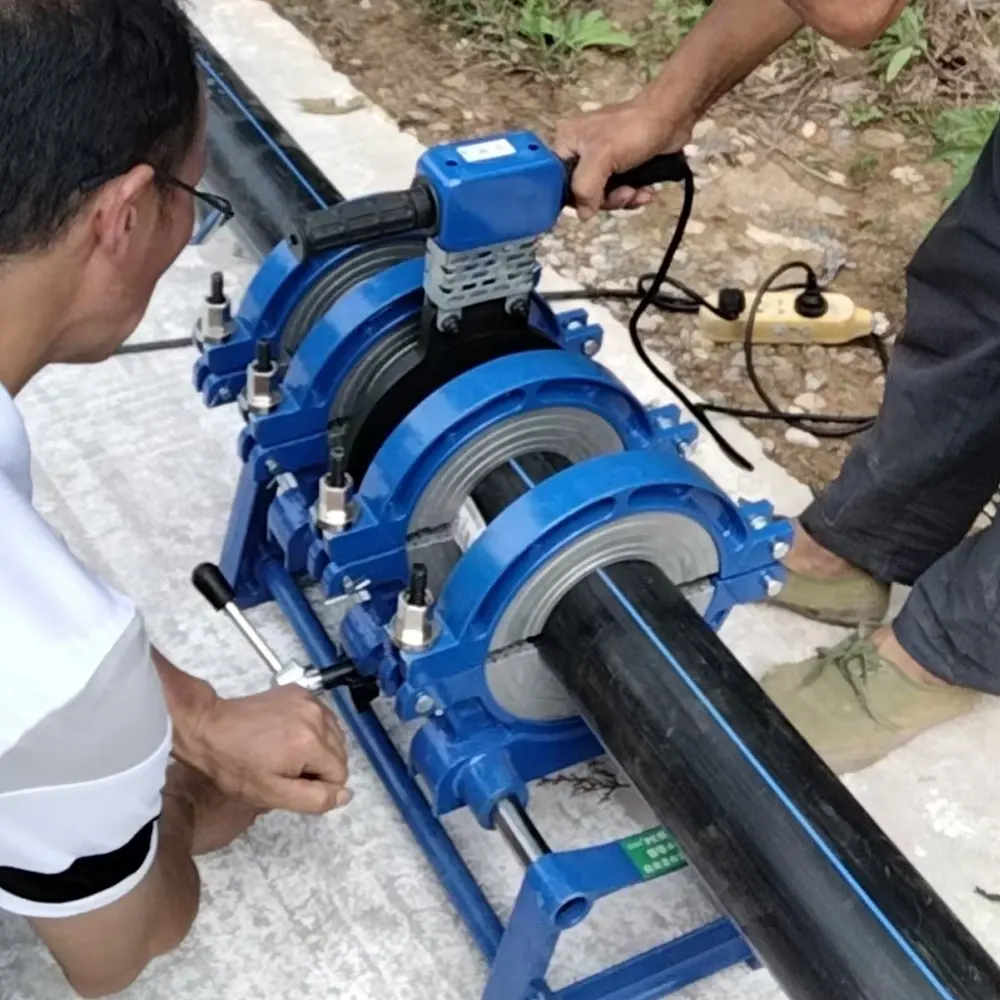
The question What Is the Best HDPE Pipe Welding Machine for Construction Companies? is more than a product-selection issue. For construction teams, the right machine can directly affect welding quality, project speed, labor efficiency, and long-term pipeline reliability. Whether the project involves water supply, gas distribution, mining, or industrial piping, the machine must deliver consistent fusion results under real jobsite conditions.
Among the many choices available, the best machine is not simply the most expensive one or the one with the most automation. It is the machine that matches your pipe diameter range, site conditions, crew skill level, budget, and project schedule. For many contractors, a butt fusion machine is the most practical and widely used solution because it creates strong, seamless joints for HDPE pipelines.
Construction companies often work under pressure. Deadlines are tight, labor resources may be limited, and each welding mistake can cause costly rework. That is why choosing a reliable HDPE pipe welding machine is a strategic decision, not just a procurement task. A high-quality machine helps ensure stable welding temperature, accurate pressure control, and proper pipe alignment, all of which are essential for joint strength.
Key point: The best HDPE pipe welding machine for construction companies should balance performance, durability, and ease of use while fitting the size and complexity of your pipeline project.
What HDPE Pipe Welding Machines Do
HDPE pipe welding machines join polyethylene pipes by heating the pipe ends, pressing them together under controlled force, and allowing them to fuse into a single continuous line. This method is widely used because it produces a leak-resistant joint with excellent structural integrity. For construction companies, this means fewer weak points and better pipeline durability over time.
There are different welding methods, but butt fusion remains one of the most popular for medium and large HDPE pipelines. It is efficient, practical, and suitable for a wide range of construction applications. When the machine is designed well, workers can complete the process with repeatable quality even on demanding sites.
⭐ Important: In construction environments, a machine with stable hydraulic control and accurate heating performance is often more valuable than one with unnecessary extra features.
Manual, Hydraulic, or CNC: Which One Fits Construction Work?
Construction companies usually compare three major machine types: manual, hydraulic, and CNC automatic butt fusion welding machines. Each type serves a different operational need.
Manual machines are generally suitable for smaller projects, simple installations, or teams that need a lower-cost solution. They are straightforward to operate and may work well when pipe sizes are limited and production speed is not the top priority.
Hydraulic butt fusion welding machines are a popular choice for construction companies because they offer better pressure control, stronger clamping force, and more stable welding results. These machines are especially useful on medium to large projects where consistency matters.
CNC automatic butt fusion welding machines are ideal for companies that need higher automation, precise control, and reduced dependence on operator skill. They are often chosen for large infrastructure projects or situations where repeatability and documentation are important.
Practical advice: If your projects vary in scale, a hydraulic or CNC model is usually a smarter long-term investment than a basic manual unit.
Main Buying Criteria for Construction Companies
To identify the best machine, construction companies should evaluate several key factors carefully.
1. Pipe diameter range
Different projects require different pipe sizes. A machine must match the diameters you use most often. Choosing a model with a broader range can improve flexibility and reduce the need for multiple machines.
2. Welding accuracy
Accurate temperature and pressure control are essential. If these elements are unstable, the fusion joint may weaken. Reliable machines are designed to keep welding conditions consistent from one joint to the next.
3. Durability and site adaptability
Construction sites can be harsh. A machine should be built with strong components, dependable hydraulics, and robust moving parts that can withstand frequent use and transport.
4. Ease of operation
Even advanced equipment should remain practical for field teams. Clear controls, readable indicators, and simple maintenance procedures help reduce operator mistakes and training time.
5. After-sales support
Technical guidance, spare parts availability, and responsive service matter just as much as the machine itself. A machine is only as good as the support behind it.
📌 Tip: Construction companies should ask suppliers for test records, welding parameters, and quality inspection standards before purchase.
Why Hydraulic Butt Fusion Machines Are Often the Best Choice
For many construction companies, hydraulic butt fusion machines provide the best overall value. They combine practicality, power, and reliable joint quality. The hydraulic system helps maintain stable pressure during the fusion process, which is essential for creating strong pipe connections.
These machines are especially useful when the project involves repetitive welding operations. Because the hydraulic function reduces manual effort and improves pressure consistency, workers can complete tasks more efficiently. This is one of the main reasons contractors prefer hydraulic solutions for field work.
When sourced from an experienced manufacturer such as JQ-Fusion, hydraulic equipment can also be customized for different voltages, configurations, and brand requirements. This is helpful for contractors who work across regions or need a machine tailored to local site conditions.
Best for: companies seeking a balance of strength, efficiency, and cost control.
The Role of Automation in Modern Construction
Automation is becoming more important in pipeline construction because it reduces human error and speeds up production. CNC automatic butt fusion welding machines can store parameters, guide operators through the welding cycle, and improve repeatability. This is especially valuable for large-scale projects where hundreds of joints may need to be completed under the same specification.
However, automation does not automatically make a machine the best option for every contractor. Smaller teams, remote sites, or projects with changing pipe requirements may not need full automation. In those cases, a strong hydraulic machine may deliver better value and easier maintenance.
Construction companies should think about how often the machine will be used, who will operate it, and whether the investment can be justified by project volume. The best choice is the one that improves workflow without adding unnecessary complexity.
To explore more about industrial welding solutions, you can visit the manufacturer’s main website: JQ-Fusion.
Why Manufacturer Experience Matters
When selecting an HDPE pipe welding machine, the manufacturer’s experience is a major factor. A company with over 20 years in the industry is more likely to understand field challenges, structural requirements, and global construction standards. Experience often translates into better machine design, more reliable testing, and stronger technical support.
JQ-Fusion specializes in HDPE pipe welding machines and provides manual, hydraulic, and CNC automatic butt fusion welding machines for different project demands. Their products are used in water supply systems, gas distribution networks, mining projects, and industrial installations worldwide.
What makes an experienced manufacturer stand out is not only product variety, but also the ability to provide customized solutions. Some projects require special voltage, unique branding, or machine configurations suited to specific work environments. OEM and ODM flexibility can make a significant difference for construction distributors and contractors.
🔧 Worth noting: A reliable supplier should offer more than a machine; it should provide engineering support, quality assurance, and fast logistics for project continuity.
Quality Control and Safety Considerations
A welding machine used in construction must perform consistently under pressure. That is why strict quality control is essential. Temperature accuracy, hydraulic stability, and clamp alignment all affect the final weld. If any one of these elements is off, the resulting joint may be weaker than required.
Professional manufacturers test each machine before delivery to make sure it meets performance standards. Certifications such as SGS also help reassure buyers that the equipment has been manufactured with safety and reliability in mind.
Construction companies should also train their operators properly. Even the best machine can produce poor results if the crew does not understand heating time, pressure settings, or alignment procedures. Safe and correct operation protects both the pipeline and the workers.
Safety first: Always verify machine calibration, power supply compatibility, and operator training before starting a welding job.
How to Evaluate Cost Effectively
Many construction companies focus on purchase price, but the true cost of a welding machine includes maintenance, downtime, spare parts, and operator efficiency. A low-cost machine that fails often can become more expensive than a higher-quality model over time.
A good buying strategy is to compare total value rather than simply the initial price. Consider how many projects the machine will support, how often it will be used, and how much time it will save in daily operation. A durable, well-supported machine often delivers better returns than a cheaper alternative.
It is also worth checking whether the supplier maintains inventory and can ship quickly. Fast delivery can prevent project delays, which is especially important when construction schedules are tight.
✅ Smart purchase logic: Choose equipment that minimizes downtime and supports long-term project productivity, not only one that looks economical on paper.
Why JQ-Fusion Is Relevant for Construction Companies
JQ-Fusion stands out because it combines manufacturing capability, customization, and global project experience. The company’s product range includes hydraulic butt fusion welding machines, automatic butt fusion welding machines, electrofusion welding machines, and multi-angle pipe fitting welding machines.
Their factory is equipped with advanced machinery and modern production lines, which helps ensure product consistency. In addition, the company emphasizes strict quality control, fast delivery, and technical support, all of which are important for construction companies that need dependable equipment on a schedule.
For buyers seeking a long-term supplier relationship, these strengths matter. A machine supplier should be able to support future expansion, replacement parts, and technical questions as project requirements evolve.
To learn more about the company and its solutions, you can also visit this official website.
Final Recommendation
The best HDPE pipe welding machine for construction companies is usually the one that offers the best combination of stable performance, practical operation, and dependable support. For smaller or simpler jobs, a manual machine may be enough. For most construction teams, however, a hydraulic butt fusion machine provides the strongest balance of cost, reliability, and usability. For large-scale or highly standardized projects, CNC automation may be the best investment.
In every case, the right machine should help your team complete welds faster, reduce errors, and deliver stronger pipeline systems. That is the real measure of value in construction work.
FAQs
Q1: What type of HDPE welding machine is best for construction companies?
A hydraulic butt fusion welding machine is often the best all-around choice because it offers strong pressure control, stable performance, and good efficiency for field projects.
Q2: Is a CNC automatic machine always better than a hydraulic one?
Not always. CNC machines are excellent for large, repetitive projects, but hydraulic machines may be more practical and cost-effective for many construction teams.
Q3: What should I check before buying a butt fusion machine?
Check pipe diameter range, welding accuracy, durability, ease of use, after-sales support, and whether the supplier can provide testing and certification documents.
Q4: Can one machine handle different construction projects?
Yes, if it has the right pipe range and configuration. Many contractors choose versatile hydraulic or CNC models to cover multiple project types.
Q5: Why is supplier support important?
Because even a high-quality machine needs technical guidance, spare parts, and reliable service to keep projects on schedule and minimize downtime.



