
In pipeline construction, welding quality determines the long-term safety, sealing performance, and service life of the entire system. Among the most commonly compared methods, field welding and workshop welding are two approaches that serve very different project needs. Although both aim to join pipes or fittings securely, their working environments, quality control methods, equipment demands, and application scenarios are not the same. Understanding the difference helps contractors, engineers, and procurement teams choose the right method for water supply systems, gas networks, mining projects, and industrial pipelines.
Field welding refers to welding performed directly at the installation site. It is used when pipe sections need to be connected on location, often in open terrain, trenches, construction zones, or remote project sites. Workshop welding, by contrast, is carried out in a controlled manufacturing or fabrication environment before the components are transported to the job site. The two methods differ not only in location but also in efficiency, repeatability, and dependency on environmental conditions.
Key idea: field welding is flexible and site-oriented, while workshop welding is controlled and production-oriented. The best choice depends on project scale, pipe diameter, installation schedule, and the level of precision required.
What Is Field Welding?
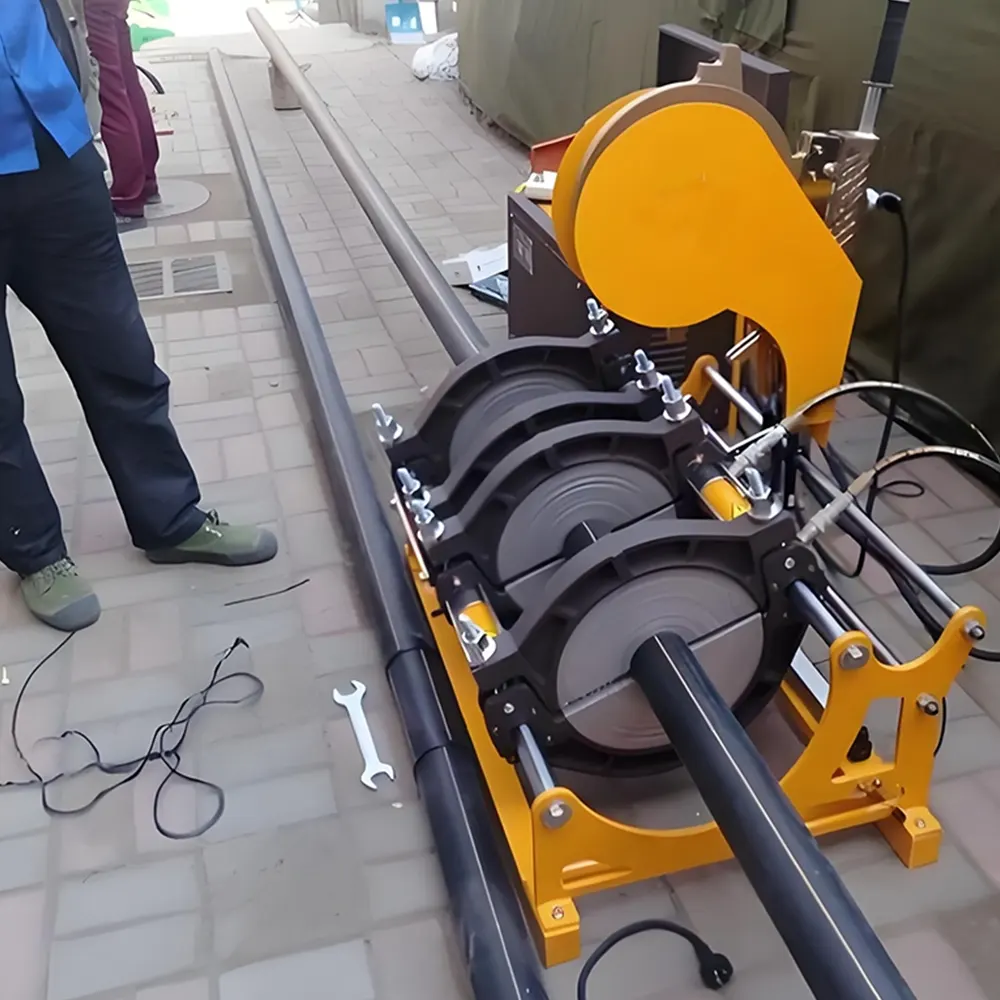
Field welding is the process of joining pipe ends or related components directly at the construction site. Because the work happens outdoors or in temporary work areas, welders must deal with wind, dust, moisture, temperature change, limited space, and uneven ground. This makes field welding highly practical for pipeline installation, especially when long pipe routes must be assembled section by section.
In many pipeline projects, field welding is unavoidable. Pipes may be too long or too heavy to preassemble fully in a workshop, or the route may require adjustments based on actual site conditions. For this reason, the welding team must bring portable machines, alignment tools, and inspection equipment to the project area. When done properly, field welding can deliver strong and durable joints that meet engineering standards.
🔧 Best suited for: pipeline trenching, remote installations, emergency repairs, municipal water systems, and gas distribution lines.
What Is Workshop Welding?
Workshop welding is performed in a manufacturing workshop or fabrication facility before installation. The main advantage is the controlled environment, where temperature, cleanliness, positioning, and equipment setup can be managed more precisely. This allows welders to achieve more consistent results, reduce defect rates, and improve production efficiency.
In workshop welding, production planning is usually more structured. Welders follow standardized procedures, and quality control can be applied at each stage of the process. Compared with site welding, workshop welding often offers better accuracy, cleaner joints, and easier inspection. It is commonly used for prefabricated pipeline sections, industrial assemblies, and components that can be manufactured in advance.
✅ Main advantage: workshop welding provides a stable production setting, which supports higher consistency and simpler quality control.
Field Welding vs. Workshop Welding: The Core Differences
The most important difference is the working environment. Field welding takes place in changing and sometimes harsh conditions, while workshop welding is performed indoors or in a protected fabrication area. This affects nearly every other aspect of the process, from machine selection to final quality assurance.
1. Environmental Control: workshop welding benefits from stable conditions, while field welding must adapt to real-world site challenges such as weather, dust, and alignment issues.
2. Quality Consistency: workshop welding usually achieves more consistent results because operators can use fixed setups and repeatable procedures. Field welding quality can vary more if the site is difficult to manage.
3. Mobility and Flexibility: field welding is more flexible because it is done on location. Workshop welding is less flexible but more efficient for prefabricated parts.
4. Productivity: workshop welding usually supports higher throughput, especially when the same type of joint is repeated many times. Field welding may take longer due to setup, transport, and site adjustments.
5. Inspection and Rework: it is easier to inspect welded joints in a workshop environment. Rework also tends to be simpler because tools, fixtures, and support staff are nearby.
How Welding Equipment Changes the Outcome
The equipment used in both methods plays a critical role in performance. For pipeline projects using HDPE, reliable butt fusion systems are essential for creating uniform and durable joints. A well-designed butt fusion machine supports both field and workshop operations by improving temperature stability, alignment accuracy, and pressure control.
In the field, equipment must be portable, durable, and easy to operate under changing site conditions. In a workshop, the same machine may be integrated into a more structured production line, where repeatability and throughput are top priorities. This is why many contractors choose machines with flexible configurations, allowing them to use the same system across different project stages.
💡 Important: the right welding equipment reduces human error, improves joint strength, and increases project efficiency in both field and workshop applications.
Why Field Welding Is Still Widely Used
Despite its challenges, field welding remains a major part of pipeline construction because it supports real-world installation needs. Large-scale projects often require work in locations where preassembled sections cannot be transported easily. For example, in water supply networks or gas distribution systems, pipe routes may extend across long distances, requiring on-site joining at multiple points.
Another advantage of field welding is adaptability. Project teams can respond quickly to route changes, unexpected terrain, or design modifications. This flexibility is especially valuable in mining projects and industrial plants, where site conditions may change during construction. When properly trained operators use suitable equipment, field welding can be efficient, reliable, and cost-effective.
Why Workshop Welding Is Preferred for Precision
Workshop welding is often the better choice when precision and repeatability matter most. Fabrication teams can prepare parts in advance, control the heat and pressure parameters more accurately, and check every joint before delivery. This is especially helpful for projects that demand strict dimensional control or for components that will be difficult to access after installation.
Because workshop welding is less affected by environmental disruptions, it usually reduces waste and lowers the chance of rework. It can also improve scheduling, since teams can process multiple assemblies in parallel. For contractors handling complex pipeline systems, prefabrication in the workshop can save time on site and reduce overall project risk.
🛠 Practical benefit: workshop welding often shortens installation time because many connection points are completed before shipment to the site.
Quality Control in Both Methods
Quality control is essential regardless of where welding takes place. In field welding, inspectors must confirm alignment, fusion quality, temperature control, and surface cleanliness under changing conditions. In workshop welding, the same checks are easier to standardize because the environment is more controlled. However, neither method can succeed without strict inspection procedures.
A professional manufacturer such as JQ-Fusion focuses on comprehensive testing and stable performance to support both application types. Modern production lines, precision machining, and strict inspection standards all contribute to reliable welding outcomes. For global contractors, this level of consistency is especially important when working on critical infrastructure projects.
Reliable quality control often includes temperature verification, hydraulic pressure stability checks, clamp alignment inspection, and trial welding tests. These measures help ensure that the final joint performs as expected over the life of the pipeline system.
How to Choose the Right Method
The right choice depends on project goals, material type, timeline, and site constraints. If the project requires maximum flexibility and direct on-site joining, field welding is usually the right solution. If the work can be prefabricated in advance and quality consistency is the top priority, workshop welding is often more efficient.
For many large projects, the best answer is not choosing only one method. Instead, companies combine both approaches: some sections are fabricated in the workshop, while final connections are completed in the field. This hybrid strategy improves productivity while maintaining control over critical weld quality.
📦 Tip for contractors: choose equipment and workflow based on pipe diameter, welding frequency, installation site conditions, and required certification standards.
The Role of a Professional Manufacturer
A trusted manufacturer can make a major difference in welding success. JQ-Fusion, with more than 20 years of industry experience, specializes in HDPE pipe welding machines and supports projects across water supply, gas distribution, mining, and industrial pipeline sectors. Its product range includes hydraulic, automatic, electrofusion, and multi-angle pipe fitting welding machines, giving contractors multiple options for different welding conditions.
The company’s OEM and ODM customization capabilities are also valuable for businesses that need specific branding, voltage settings, machine colors, or project-based configurations. Combined with global logistics support and technical guidance, these services help customers complete projects more efficiently and with greater confidence.
For projects where consistent butt fusion performance is essential, choosing the right supplier is just as important as choosing the right welding method. Reliable machinery, stable stock supply, and after-sales support can reduce delays and improve long-term operating results.
Conclusion
Field welding and workshop welding are both essential in modern pipeline construction, but they serve different purposes. Field welding offers flexibility and on-site adaptability, while workshop welding delivers higher control, better consistency, and faster prefabrication. The best projects often use both methods strategically to balance quality, schedule, and cost.
Whether you are building a water network, a gas line, or an industrial pipeline, success depends on selecting the right process, using dependable equipment, and applying strict quality standards. With the right planning and professional support, both field and workshop welding can produce durable, high-performance joints that stand the test of time.
Frequently Asked Questions
Q1: Is field welding weaker than workshop welding?
Not necessarily. When properly executed and inspected, field welding can be very strong. The main challenge is controlling environmental factors and maintaining consistent quality.
Q2: Why is workshop welding often preferred?
Workshop welding is preferred because it takes place in a controlled environment, which improves consistency, reduces defects, and simplifies inspection.
Q3: Can the same welding machine be used for both methods?
Yes, many modern butt fusion systems are suitable for both field and workshop use, especially when they are designed for portability, accuracy, and stable pressure control.
Q4: Which method is better for large pipeline projects?
It depends on the project structure. Large projects often use a combination of both methods to improve efficiency and maintain quality.
Q5: What should contractors prioritize when choosing a welding method?
Contractors should consider site conditions, pipe size, required quality level, production speed, inspection needs, and available equipment support.



