
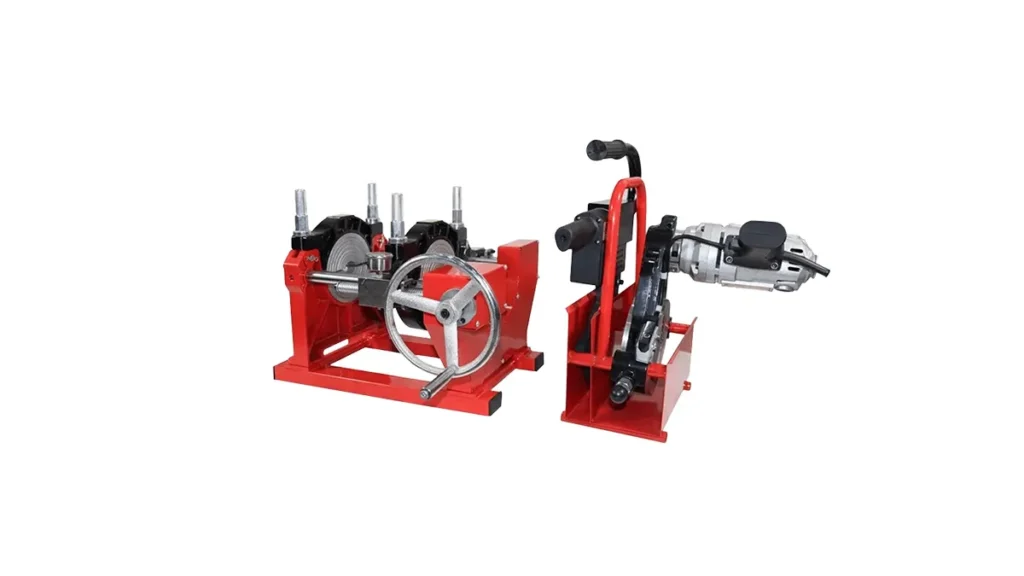
When pipeline contractors, distributors, and project engineers evaluate welding equipment, one of the first decisions they face is whether to choose an automatic or manual fusion machine. Both are designed to join thermoplastic pipes through heat and pressure, but they differ greatly in operation, accuracy, productivity, cost, and the type of projects they best support. Understanding these differences is essential for selecting the right equipment and achieving reliable, long-lasting joints in the field.
In simple terms, a manual fusion machine depends more on the operator’s experience and physical control, while an automatic fusion machine uses programmed or semi-programmed procedures to reduce human variation. That basic distinction affects nearly every part of the welding process, from alignment and heating to pressure control and quality consistency.
For contractors working on water supply systems, gas distribution networks, mining projects, or industrial pipelines, the choice is not just about technology. It is about productivity, labor cost, quality requirements, and how much standardization the project demands. If you want to explore a reliable butt fusion machine option for different project needs, understanding the machine type is the first step.
What Is a Manual Fusion Machine?
A manual fusion machine is operated mainly by the technician’s hands and experience. The operator controls key steps such as pipe alignment, heating time, pressure application, and joining force. This type of machine is often preferred for simpler projects, smaller pipe sizes, temporary installations, or sites where budget and flexibility are important.
Manual systems are valued for their straightforward structure, lower initial investment, and ease of maintenance. For many users, they offer a practical balance between affordability and function.
However, because more steps depend on the operator, results can vary from one weld to another. A skilled worker can produce excellent joints, but inconsistent technique, fatigue, or poor site conditions may affect weld quality. In this sense, manual machines are highly dependent on training and discipline.
What Is an Automatic Fusion Machine?
An automatic fusion machine is designed to make the welding process more standardized and less dependent on manual adjustments. Many of these machines use hydraulic systems, electronic control units, or CNC-driven settings to regulate temperature, pressure, and timing with higher precision. The goal is to improve repeatability and reduce human error.
Automatic models are especially useful in projects where joint quality must remain highly consistent across many welds. This is important in large-diameter pipelines, critical gas systems, and infrastructure projects where compliance and traceability matter. With automatic control, operators can focus more on preparation and monitoring, while the machine handles the core process parameters.
Key advantage: automatic fusion machines improve consistency, reduce operator dependency, and support higher productivity on demanding projects.
Core Differences Between Automatic and Manual Fusion Machines
The differences between the two types become clear when they are compared in practical use. The first major difference is control. Manual machines rely on operator judgment, while automatic machines use programmed control to standardize the welding cycle. This means automatic units are generally better at maintaining stable temperature and pressure across multiple welds.
The second difference is speed and efficiency. Manual machines may be suitable for occasional or smaller-scale use, but automatic machines are built to support continuous work. When a contractor must complete many joints in a limited time, automation reduces delays and improves overall jobsite efficiency.
The third difference is quality consistency. A manual machine can produce excellent results in skilled hands, but the risk of variation remains. Automatic machines help minimize that risk by ensuring each joint follows the same process parameters. This is a major benefit in regulated or high-value projects.
The fourth difference is cost. Manual machines usually have a lower purchase price and are easier to move and service. Automatic machines cost more upfront, but they can save money over time by reducing rework, improving throughput, and lowering the chance of weld failure.
The fifth difference is training. Manual machines require experienced welders who understand the process well. Automatic systems are generally easier for teams to adopt because the machine handles much of the process logic, although proper training is still necessary.
Where Manual Machines Make the Most Sense
Manual fusion machines are often the right choice for smaller contractors, repair teams, and projects with limited budgets. They are also practical in remote areas where power supply, digital control, or advanced maintenance support may be limited. If the project involves short pipeline sections or occasional welding tasks, the simplicity of a manual machine can be a real advantage.
They are also useful when operators need maximum flexibility. Because the process is controlled directly by the technician, experienced welders can adapt quickly to site conditions and unusual pipe arrangements. In some cases, this hands-on control is preferred by professionals who trust manual adjustment more than automated logic.
Manual machines are often chosen for: small projects, budget-sensitive jobs, field repairs, and operators who already have strong welding experience.
Where Automatic Machines Deliver the Best Value
Automatic fusion machines are better suited to larger, more demanding, or highly standardized projects. They are widely used in municipal water systems, gas distribution networks, mining operations, and industrial pipeline installations where reliability and repeatability are critical.
These machines are also ideal for contractors who manage multiple crews or large-volume work. Standardized controls help different operators produce similar results, which reduces quality variation between shifts or work sites. That is especially important when a project requires documentation, inspections, or strict compliance with international standards.
In many modern pipeline projects, automation is no longer a luxury but a practical necessity. The ability to monitor temperature accuracy, hydraulic pressure stability, and clamp alignment improves confidence in each weld. This is one reason why many professional manufacturers now offer advanced automatic and CNC fusion solutions.
Quality and Reliability in Real Projects
Welding quality is the most important factor in any fusion process. A pipe joint must be strong, aligned, and uniform to perform well over many years. If a weld fails, the cost is not only the repair itself but also downtime, labor losses, and possible safety concerns. This is why machine selection matters so much.
Manual machines can create high-quality welds, but their success depends heavily on the operator’s skill and the site environment. Dust, wind, heat, and rushed work can all influence the result. Automatic machines reduce this vulnerability by standardizing the process and helping users maintain the correct parameters throughout the cycle.
Important note: in critical infrastructure work, consistency often matters more than raw speed, which is why many teams prefer automatic systems.
Cost Comparison: Upfront Price vs Long-Term Value
At first glance, manual machines appear more economical because they have a lower initial cost. For smaller businesses or entry-level users, this can be a decisive factor. Maintenance can also be simpler and cheaper because the design is often less complex.
But when looking at total project cost, automatic machines may offer better long-term value. Faster production, reduced rework, fewer failed joints, and lower dependence on highly specialized labor can all contribute to a stronger return on investment. For large contractors, these savings can quickly offset the higher purchase price.
Choosing between the two should not be based only on the sticker price. It should be based on how often the machine will be used, how critical the welds are, and whether the project benefits more from flexibility or from automation.
How JQ-Fusion Supports Different Project Needs
JQ-Fusion focuses on HDPE pipe welding solutions for global pipeline projects, offering manual, hydraulic, and CNC automatic butt fusion welding machines. With more than 20 years of industry experience, the company serves customers in water supply, gas distribution, mining, and industrial construction markets.
Its manufacturing approach emphasizes stable performance, strict quality control, and customizable configurations. This is important because no two projects are exactly alike. Some customers need compact manual models, while others need advanced automated systems with specific voltage, branding, or size requirements.
JQ-Fusion also supports OEM and ODM customization, which helps distributors and contractors build a stronger market position. Whether the priority is fast delivery, technical support, or tailored machine design, a professional manufacturer can make a significant difference in project success.
For buyers who want a dependable product line, JQ-Fusion’s range includes hydraulic butt fusion welding machines, automatic butt fusion welding machines, electrofusion welding machines, and multi-angle pipe fitting welding machines. These options allow users to match equipment to application requirements more accurately.
Factory strength, inventory availability, and technical support are not just selling points; they are practical advantages that help projects stay on schedule.
How to Choose the Right Machine for Your Project
If you are deciding between automatic and manual fusion machines, start with the project scale. Small jobs with limited volume may not justify automation, while large and repeated installations often benefit greatly from it. Next, consider the skill level of your team. Experienced welders may work effectively with manual systems, but mixed or rotating teams often perform better with automation.
Then evaluate the required quality standards. If the project is tied to strict inspection or high-risk infrastructure, the more controlled process of an automatic machine can reduce uncertainty. Finally, consider service support, spare parts access, and delivery speed. A machine is only as useful as the support behind it.
In short, the best machine is not always the most advanced one. It is the one that matches the project’s workload, tolerance for risk, and operational environment.
Final Thoughts
Automatic and manual fusion machines each have a clear place in pipeline construction. Manual machines offer simplicity, affordability, and flexibility, making them suitable for smaller or less demanding applications. Automatic machines provide precision, consistency, and efficiency, making them the preferred choice for larger and more critical projects.
The right decision depends on your budget, your team’s experience, and the quality level your project demands. For many businesses, the most practical approach is to match the machine to the job rather than choosing based on price alone. By doing so, contractors can improve weld quality, control costs, and support long-term project reliability.
Frequently Asked Questions
Q1: Is an automatic fusion machine better than a manual one?
Not always. Automatic machines are better for consistency and large-scale work, while manual machines are better for simplicity, lower cost, and flexible small projects.
Q2: Do manual machines require more skill?
Yes. Manual systems rely more on the operator’s experience, so training and welding discipline are very important.
Q3: Which machine is best for gas pipeline projects?
In many gas pipeline applications, automatic or hydraulic systems are preferred because they offer better control and more consistent joint quality.
Q4: Can automatic machines reduce welding errors?
Yes. They help reduce human error by standardizing temperature, pressure, and timing during the fusion cycle.
Q5: How do I choose the right supplier?
Look for industry experience, quality control, customization capability, global support, and a product range that matches your project needs.



