
When people ask “What Are the Correct Butt Fusion Welding Pressure Settings?”, they are usually trying to solve a practical problem on the job site: how to create a strong, leak-free joint without wasting pipe, time, or energy. In butt fusion welding, pressure is not just a number on a gauge. It is a critical part of the process that affects bead formation, heating quality, fusion integrity, and long-term joint reliability. If the pressure is too low, the pipe ends may not fully merge. If it is too high, molten material can be forced out excessively, weakening the joint or distorting alignment.
The correct pressure settings depend on several factors, including pipe diameter, pipe material, wall thickness, machine type, and the specific fusion standard being followed. HDPE pipe systems, for example, often require precise control at each stage of the cycle: facing, alignment, heating, changeover, and cooling. Operators who understand these stages can produce stronger welds and reduce failure risk. For contractors, utility installers, and distributors, mastering pressure settings is one of the fastest ways to improve welding consistency and project performance.
⚠️ Important: There is no universal single pressure value that works for every butt fusion job. The correct setting is always calculated or selected based on the machine, the pipe specification, and the welding procedure.
What Butt Fusion Pressure Really Means
Butt fusion pressure refers to the force applied to the pipe ends during the fusion process. In a typical HDPE butt fusion cycle, pressure is used to align the pipes, create a heating contact surface, and then press the softened ends together during changeover and cooling. The hydraulic system or mechanical system of the machine controls this force, and the operator must keep it stable and consistent.
The pressure must be strong enough to maintain full end contact, but not so high that it causes excessive bead roll-back or squeezes out too much molten material. In simple terms, the goal is to create a clean, uniform fusion interface where the plastic molecules bond under heat and pressure. This is why accurate pressure control is essential for every project, from small municipal lines to large industrial pipelines.
✅ Key point: Pressure is not used the same way in every phase. Pre-heating, fusion, and cooling all require different handling, and the operator must follow the machine’s procedure exactly.
Main Factors That Affect Correct Pressure Settings
Several variables determine the correct butt fusion pressure setting. Understanding them helps you avoid guesswork and maintain a stable welding result.
1. Pipe diameter and wall thickness
Larger-diameter pipes and thicker walls usually require different pressure calculations than smaller pipes. The greater the pipe size, the more force may be needed to keep the pipe ends properly aligned and heated evenly.
2. Pipe material
Most butt fusion projects involve HDPE, but different grades and manufacturers can behave slightly differently under heat. The melt flow characteristics of the material influence how much pressure is safe and effective.
3. Machine type
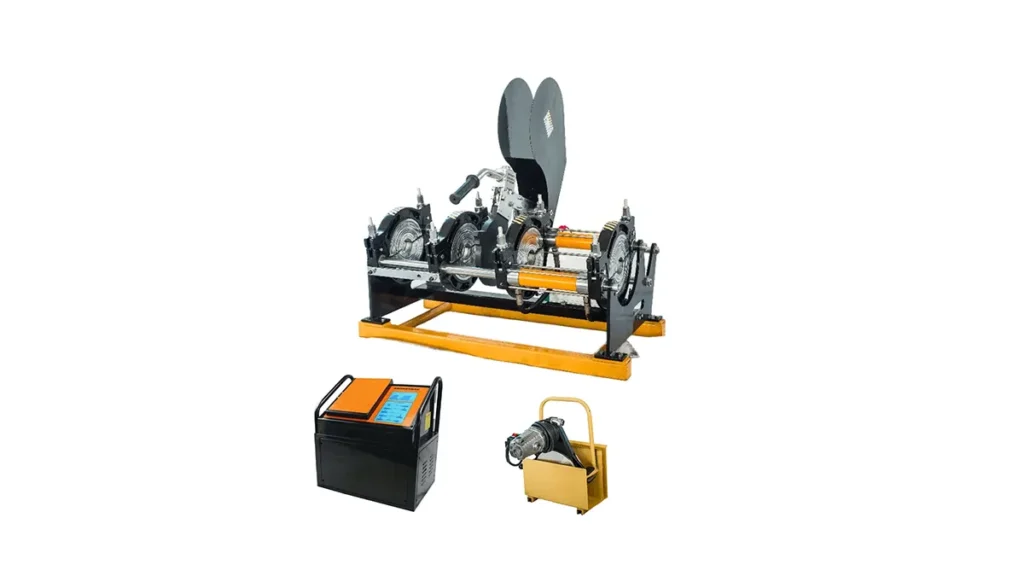
Manual, hydraulic, and CNC automatic machines handle pressure differently. A CNC machine can usually deliver more repeatable settings, while manual systems depend more on operator skill and careful monitoring. If you are comparing machine options, you can learn more about a reliable butt fusion machine designed for stable pressure control and professional pipeline applications.
4. Welding standard or procedure
International standards and project specifications may define exact pressure ranges, heating times, and cooling times. Always follow the applicable welding procedure specification rather than using a random preset.
5. Environmental conditions
Temperature, wind, humidity, and surface condition can influence the welding result. Although these factors do not directly change the machine setting, they can affect the way pressure performs in practice.
Typical Pressure Stages in Butt Fusion Welding
Correct butt fusion welding is usually divided into several stages, and each stage requires attention to pressure.
Stage 1: Alignment and clamping
The pipes are placed into the clamps and aligned. Pressure here should be enough to hold the pipe securely without deforming the ends.
Stage 2: Facing
Facing removes oxidation and creates parallel pipe ends. Pressure must support stable cutting, but not excessive force that could damage the pipe face.
Stage 3: Heating
The heating plate melts the pipe ends. The pressure is usually adjusted to maintain contact without crushing the softened surface.
Stage 4: Changeover
This is the short period when the heating plate is removed and the pipe ends are brought together. Pressure should be applied quickly and accurately to prevent heat loss.
Stage 5: Cooling
During cooling, the joint must remain under controlled pressure to preserve alignment and joint strength until it solidifies.
How to Determine the Correct Pressure Setting
The most reliable way to determine correct pressure is to use the welding machine’s procedure chart, the pipe manufacturer’s guidance, and the project standard. In many cases, the machine manual provides a pressure table or a formula that takes pipe size and system resistance into account. A common working method is to calculate the drag pressure first, then add it to the required fusion pressure so the operator knows the total hydraulic setting needed.
Drag pressure is the resistance created by the pipe moving through the machine clamps and hydraulic system. If this is ignored, the actual force on the pipe end may be lower than expected. That is why many professional installers perform a test before welding, especially on larger pipes or in field conditions where alignment resistance can vary.
📌 Best practice: Record your drag pressure, machine pressure, heating plate temperature, and cooling time for each job. This helps improve repeatability and troubleshooting later.
Common Pressure Mistakes to Avoid
Many weld failures are caused not by the machine itself, but by poor pressure control. The following mistakes are especially common:
Using too much pressure during heating
Excess force can over-squeeze the pipe ends, reducing proper melt flow and creating an uneven fusion surface.
Applying too little pressure during fusion
If the pipe ends do not bond fully, the joint may look acceptable but fail under load or internal pressure.
Ignoring machine calibration
A hydraulic gauge that is not calibrated can mislead the operator and produce inconsistent results across multiple joints.
Changing settings without documentation
When technicians adjust pressure without recording it, troubleshooting becomes much harder, and weld quality becomes less predictable.
Poor pipe preparation
Even with correct pressure, dirty, misaligned, or poorly faced pipe ends can weaken the fusion result.
Why Equipment Quality Matters
Pressure accuracy depends heavily on machine design and manufacturing quality. A stable butt fusion system should provide smooth hydraulic control, accurate temperature regulation, strong clamp alignment, and reliable repeatability. This is especially important in large-scale infrastructure projects where one weak joint can interrupt the entire network.
Manufacturers with strong technical capability often focus on durability, precision machining, and strict testing procedures. JQ-Fusion, for example, develops manual, hydraulic, and CNC automatic fusion machines for different pipe diameters and project types. Their equipment is used in water supply systems, gas distribution networks, mining projects, and industrial pipeline installations. When selecting a machine, buyers should look for stable performance, easy operation, and strong after-sales support, not only the lowest price.
For contractors who need reliable production and customized solutions, choosing a factory with OEM and ODM capability can also be a major advantage. Custom voltage, branding, color, configuration, and functional upgrades can help a business match local market demand or project-specific requirements.
Practical Tips for Better Pressure Control
To improve your butt fusion results, keep the following habits in mind:
🔧 Inspect the machine before every shift. Check hydraulic oil, clamp movement, plate condition, and gauge accuracy.
🔧 Keep the pipe ends clean and square. Accurate pressure cannot fix poor preparation.
🔧 Use the same procedure consistently. Repeatable settings lead to repeatable weld quality.
🔧 Train the operator. Skilled personnel can spot pressure problems before they become expensive failures.
Good pressure control is not just about reading a gauge. It is about understanding how the machine, pipe, and process work together. When operators are properly trained and the equipment is well maintained, fusion joints become stronger, more uniform, and more reliable over time.
How JQ-Fusion Supports Professional Welding Projects
JQ-Fusion focuses on delivering dependable butt fusion solutions for global pipeline projects. With more than 20 years of industry experience, the company offers a wide product range, including hydraulic butt fusion welding machines, automatic butt fusion welding machines, electrofusion welding machines, and multi-angle pipe fitting welding machines. Their machines are produced with modern manufacturing technology and undergo strict quality control, including temperature accuracy checks, hydraulic pressure stability testing, and clamp alignment inspection.
For international buyers, this kind of quality assurance matters because it reduces failure risk in the field. Reliable equipment supports better pressure consistency, which directly improves joint quality. In addition, fast delivery, large inventory, and full technical support make project execution smoother for contractors working under tight schedules.
Frequently Asked Questions
Q1: Is there one exact pressure setting for all butt fusion jobs?
No. The correct setting depends on pipe size, material, machine type, and welding procedure.
Q2: What happens if the pressure is too high?
Too much pressure can distort the pipe end, remove too much molten material, and weaken the fusion joint.
Q3: What happens if the pressure is too low?
The pipe ends may not fuse properly, leading to weak or unreliable joints that may fail under stress.
Q4: Should drag pressure be included in the final setting?
Yes. Drag pressure should be added to the required fusion pressure to calculate the true machine setting.
Q5: Why is machine quality important for pressure control?
A well-built machine provides stable hydraulic performance, accurate control, and repeatable weld results across different job conditions.
In summary, correct butt fusion welding pressure settings are essential for producing strong, durable joints. The best results come from proper calculation, careful pipe preparation, accurate machine control, and strict adherence to the welding procedure. If you combine the right pressure with reliable equipment and trained operators, you can achieve consistent performance on projects of any scale.



